Page 2
OriginalEssentially, both companies optimally rank order customers/countries according to increasing collection cost and collect according to that order. In both cases, Companies B and C can increase the collection volume by collecting from progressively more distant (and hence more expensive) sources. Consequently, increasing the collection volume yields a total cost function that exhibits diseconomies of scale in volume.1 In addition to these volume-dependent reverse logistics costs, reverse supply chains may incur costs associated with securing a supply of used products to be collected, for example, advertisement or investment costs.
中文在这篇笔记中,我们通过探索不同运营环境下依赖数量的逆向物流成本的影响来扩展他们的模型。 使用具有利率依赖性(投资成本)和依赖于数量(逆向物流成本)的组成部分,后者可以表现出规模经济或规模不经济,我们发现,如果收集成本结构使得制造商可以通过零售商管理的收集来激励零售商增加销量,从而获得利润,制造商更喜欢零售商管理的收集。 由于成本纯粹取决于数量,当收集存在规模经济时就会发生这种情况; 由于规模不经济,制造商更愿意管理收集。 由于成本纯粹取决于费率,当规模效应足够强时,零售商管理的收集是最佳的; 当它较弱时,制造商管理的收集是最佳选择。
OriginalThe effect of such costs on collection channel choice has been modeled and analyzed in Savaşkan et al. (2004), who use an investment cost that is a convex increasing function of the collection rate and conclude that retailer-managed collection is optimal for the manufacturer. In this note, we extend their model by exploring the effect of volume-dependent reverse logistics costs under different operating environments. Using a reverse channel cost structure that has rate-dependent (investment cost) and volume-dependent (reverse logistics cost) components, where the latter can exhibit either economies or diseconomies of scale, we find that if the collection cost structure is such that the manufacturer can profitably incentivize the retailer to increase its sales volume with retailer-managed collection, retailer-managed collection is preferred by the manufacturer.
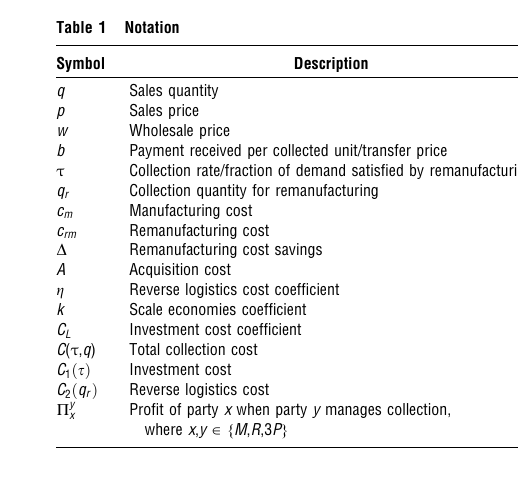
中文制造商从来不喜欢第三方管理的集合。 我们的笔记的两个贡献是揭示基于反向的重要性渠道选择上的收集成本的结构,并描述在什么条件下每个反向渠道选择应该是首选。 2. 建模假设 重点关注成本结构对收集渠道选择,我们使用与 Savaşkan 等人类似的模型。 (2004),他们研究了同样的问题; 主要区别在于,我们纳入了一个成本组成部分,以捕获收集量中的经济或规模不经济,并且我们通过更广泛的参数值来分析投资成本案例,因为我们发现这个分析很有洞察力。 我们还在支持信息的附录中扩展了他们的可区分新产品和再制造产品的模型。 我们简要总结了 Savaşkan 等人的模型。 (2004) 下面请读者参阅该论文,以详细讨论模型假设。 为了方便起见,表 1 总结了所使用的符号。 2. 1. 前向渠道 无差异的新产品和再制造产品通过同一零售商以分散的、不协调的两级(制造商和零售商)的形式销售供应链。
OriginalWith purely volume-dependent cost, this happens when there are economies of scale in collection; with diseconomies of scale, the manufacturer prefers to manage collection. With purely rate-dependent cost, retailer-managed collection is optimal when the scale effect is strong enough; when it is weak, manufacturermanaged collection is optimal. Third-party-managed collection is never preferred by the manufacturer. The two contributions of our note are to reveal the importance of basing the reverse channel choice on the structure of the collection cost and to describe under what conditions each reverse channel choice should be preferred.
中文无差异化产品的典型例子是柯达一次性相机,客户知道该公司在某些相机的生产中使用了旧零件,但不知道特定产品是否包含二手零件。 制造商是 Stackelberg 的领导者,向零售商提供批发价格合同。 由于产品没有差异化,制造商以相同的批发价 w 向零售商销售新产品和再制造产品,零售商又以相同的价格 p 在市场上销售这两种产品。 需求由 q = (1 p)/ 给出,其中 / 是常数。 生产新产品的成本为cm,生产再制造产品的成本为crm。 我们假设 cm \ 1 以确保新产品的正利润率下的正需求。
Original2. Modeling Assumptions To focus on the effect of cost structure on the collection channel choice, we use a similar model as in Savaşkan et al. (2004), who study the same question; the main differences are that we incorporate a cost component that captures economies or diseconomies of scale in the collection volume and that we analyze the investment cost case over a broader set of parameter values, as we find this analysis to be insightful. We also extend their model for differentiable new and remanufactured products in the Appendix in the Supporting Information.
中文将 τ 定义为再制造单位满足的需求比例。 那么,制造商向零售商销售 q 个商品的利润为 wq cmð1 sÞq crmsq。 将 D ¼ cm crm [ 0 定义为单位成本节省再制造,我们可以将该利润重写为 ðw cm þ DsÞq。 请注意,对于无差异化的产品,最好重新制造并销售尽可能多的退回产品; 因此,τ 也是上一代销量 q 的产品回收率(在所有退货均可再制造的隐含假设下)。 收集量,qr,等于τq。 收集率τ的可行范围在实践中可能是有限的。
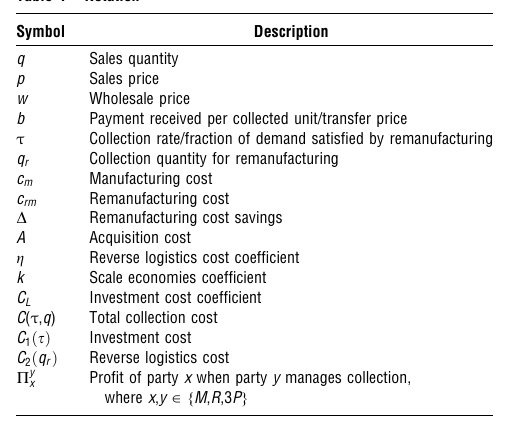
OriginalWe briefly summarize the model in Savaşkan et al. (2004) below and refer the reader to the paper for a detailed discussion of the model assumptions. For convenience, Table 1 summarizes the notation used. 2.1. The Forward Channel Undifferentiated new and remanufactured products are sold through the same retailer in a decentralized uncoordinated two-echelon (manufacturer and retailer) supply chain. The archetypal example for undifferentiated products is the Kodak single-use camera, where the customer knows that the company utilizes used parts in the production of some cameras, but does not know whether a specific product contains used parts or not.
中文这可以通过假设 smax 为 0 来捕获。 在我们的分析中,不失一般性地假设 smax 1/4 1; 对于 smax \ 1,所有 s 1/4 1 的结果都将更改为 s 1/4 smax。 2. 2. 反向渠道 催收管理方定义为催收数量的决定者,无论谁处理实际的收集操作。 该方可以是制造商、零售商或第三方(图 1)并产生线性(例如,每单位常数)获取成本 Aqr 和收集成本 C(τ;q)。 如果零售商或第三方管理收货,她将所有收集的单位转移给制造商并收到每单位的转移价格 b。 2. 3. 收集成本 我们将收集销量 q 的一小部分 τ 的总成本建模为 Cðs;
OriginalThe manufacturer is the Stackelberg leader and offers a wholesale price contract to the retailer. Since the products are undifferentiated, the manufacturer sells both new and remanufactured products to the retailer at the same wholesale price w, who in turn sells both products at the same price p on the market. The demand is given by q = (1�p)/, where / is a constant. The cost of producing a new product is cm and the cost of producing a remanufactured product is crm. We assume cm \ 1 to ensure positive demand at positive margin for new products.
中文qÞ ¼ C1ðsÞ þ C2ðqrÞ,qr ¼ sq。 第一个组成部分 C1ðsÞ 考虑在需要采取此类行动时激励消费者退货的成本。 尤其,我们将 C1ðsÞ ¼ CLs2 定义为实现 τ 收集率的总成本(如 Savaşkan 等人,2004 年)。 该成本项反映了 Savaşkan 等人分析的投资成本。 (2004)。 正如他们的论文中所述,可能需要促销/广告活动来鼓励消费者退货。 预计此类投资的回报会递减; s ¼ ffiffiffiffiffiffiffiffiffiffiffiffi C1=CL p 的增长慢于总投资C1 的增长。
OriginalDefine τ as the fraction of demand satisfied by remanufactured units. Then, the manufacturer's profit from selling q items to the retailer is wq � cmð1 � sÞq � crmsq. Defining D ¼ � cm � crm [ 0 as the cost saving per unit from remanufacturing, we can rewrite this profit as ðw � cm þ DsÞq. Note that with undifferentiated products, it is optimal to remanufacture and sell as many of the returned units as possible; thus, τ is also the collection rate of products from the previous generation's sales volume q (under the implicit assumption that all returns are remanufacturable).
中文第二个组成部分考虑逆向物流成本,即实际收集19375956、2013、5、北京化学工业大学下载自https://onlinelibrary. wiley. com/doi/10. 1111/j. 1937-5956. 2012. 01426. x,Wiley 在线图书馆 [31/05/2026]。 有关使用规则,请参阅 Wiley 在线图书馆的条款和条件 (https://onlinelibrary. wiley.
OriginalThe collection volume, qr, equals τq. The feasible range of the collection rate τ might be limited in practice. This can be captured by assuming 0 � s � smax. In our analysis, we assume without loss of generality that smax ¼ 1; with smax \ 1, all results where s� ¼ 1 will change to s� ¼ smax. 2.2. The Reverse Channel The party that manages collection is defined as the one who determines the collection quantity, regardless of who handles the actual collection operation. This party can be the manufacturer, the retailer, or a third party (Figure 1) and incurs a linear (e.g., constant per unit) acquisition cost Aqr and collection cost C(τ;q).
中文com/terms-and-conditions); OA 文章受适用的知识共享许可产品 C2ðqrÞ ¼ gqk r 管辖,根据馆藏卷 qr 进行定义。 C2ðqrÞ 的建模是我们模型的一个新颖之处,这源于我们的实践经验。 在此模型中,k < 1 体现了规模经济,而 k > 1 体现了收集运营成本中的规模不经济,这两者都可以在实践中观察到。 要了解 k < 1 的凹成本结构如何出现,请考虑喜欢使用下降策略的公司,根据该规定,消费者可以将用过的产品扔到指定地点。 例如,我们合作的欧洲逆向物流公司Cycleon,在欧洲邮局收集二手产品。
OriginalIf the retailer or the third party manages collection, she transfers all collected units to the manufacturer and receives a transfer price b per unit. 2.3. The Collection Cost We model the total cost to collect a fraction τ of sales volume q as Cðs; qÞ ¼ C1ðsÞ þ C2ðqrÞ, with qr ¼ � sq. The first component C1ðsÞ considers the cost of incentivizing the consumers to return their products, when such action is needed. In particular, we define C1ðsÞ ¼ � CLs2 as the total cost to achieve a collection rate of τ (as in Savaşkan et al.
中文Cycleon 与欧洲邮政网络签订依赖数量的价格(例如数量折扣),并向客户收取依赖数量的价格。 因此,对于使用 Cycleon 服务的公司来说,收集额外产品的边际成本随着收集量的增加而减少,这样人们就会观察到规模经济。 要了解 k > 1 的凸成本结构在实践中如何出现,请考虑第 1 节中简要提到的两个示例。 B 公司,主要向汽车行业供货的化学品生产商,从客户那里收集一定数量的废旧产品(占其销售额的一小部分),并可以在生产中重复使用这些材料过程。
Page 5
Original3.4.1. Scale Economies in the Collection Volume. PROPOSITION 1. Under economies of scale in collection (k < 1), the optimal solution with manufacturer-, retailer-, or third-party collection is at one of the two boundaries s� ¼ 0 or s� ¼ 1. PROOF. All proofs are provided in the Appendix. This result is intuitive: The collection cost exhibits economies of scale in the collection volume, while the revenue from collection increases linearly in the collection volume. Thus, the profit in the reverse channel is convex increasing in the collection volume.
中文尽管在零售商收集场景中观察到批发价较高,高批发价和高转移价的综合效应是,与制造商管理的收集相比,有效批发价 w b 更低,需求 q 更高,通过零售商管理的收货,为制造商带来更高的利润。 对于第三方管理的收集,制造商的处境比制造商管理的收集更糟糕,因为他不仅只有一个杠杆来迫使零售商增加收款量,而且他还与第三方分享反向渠道的利润。 3. 4. 2. 集合中的规模不经济体积。 在规模不经济下,存在一个阈值 g ¼ D A ð/ð1 cmÞ=4Þk 1 使得 s \ 1 对于 g [ g 无论谁管理收集。
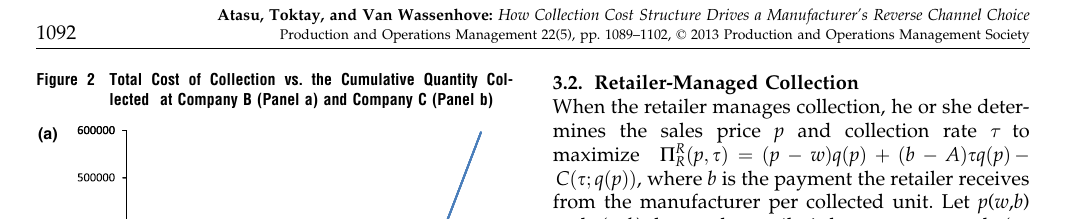
OriginalAs long as the party that manages collection finds collection profitable for any collected quantity, he or she is better off by choosing a larger collection volume, so that s� ¼ 1; otherwise s� ¼ 0. Unfortunately, a solution to the embedded optimization problem cannot be obtained in closed form for general k < 1 values (b) (a) Figure 2 Total Cost of Collection vs. the Cumulative Quantity Collected at Company B (Panel a) and Company C (Panel b) 19375956, 2013, 5, Downloaded from https://onlinelibrary.wiley.com/doi/10.1111/j.1937-5956.2012.01426.x by Beijing University of Chemistry Technology, Wiley Online Library on [31/05/2026].
中文在这种情况下,我们分析地解决问题并诉诸于g \ g 的数值分析。 命题 2. 设 k > 1 且 g [ g。 制造商在管理收货时获得更多利润。 通过制造商管理的系列,收款率高于零售商或第三方管理的收款,但均衡批发价、销售价、因此,所有情况下的销售数量都是相同的。 在 s \ 1 (即 q r \ q )的参数范围内,无论谁管理收集,正向和反向渠道的经济性是解耦的(处于均衡状态)。 这解释了为什么均衡批发价格(以及零售价格和销售额)表 2 制造商利润、销售价格、对于以下参数子集,k < 1 时不同收款渠道下的收款率和转移价格:cm = 0.
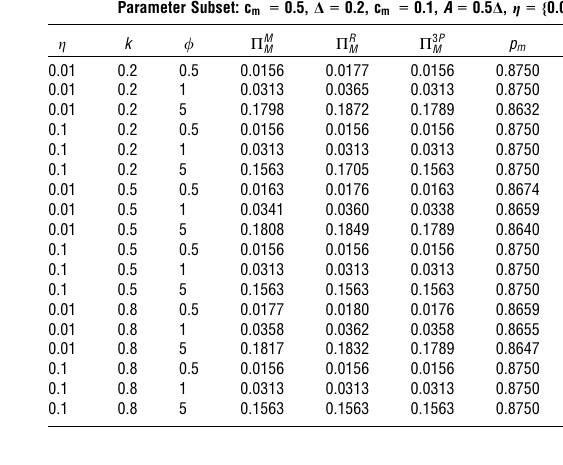
OriginalSee the Terms and Conditions (https://onlinelibrary.wiley.com/terms-and-conditions) on Wiley Online Library for rules of use; OA articles are governed by the applicable Creative Commons License because the best response function of the party that manages collection needs to be derived from the optimization of a kth order polynomial and cannot be characterized in closed form. However, it is possible to do so numerically. Our numerical study2 (from which a representative sample is presented in Table 2) reveals the following.
中文5,D = 0. 2,cm = 0. 1,A = 0. 5D,g = {0. 01,0. 1},/ = {0. 5,1,5},k = {0. 2,0. 5,0. 8}。 g k / PM M PR M P3P M pm pr p3p sM sR s3p brb3p 0. 01 0. 2 0. 5 0. 0156 0. 0177 0. 0156 0. 8750 0. 8636 0. 8750 0 1 0 0.
OriginalOBSERVATION 1. When the retailer finds it profitable to collect (i.e., sR ¼ 1) under economies of scale (k < 1), manufacturer profits are maximized under retailer-managed collection. The manufacturer may find retailer-managed collection so profitable that b may be larger than D in equilibrium. The sales price is the lowest with retailer-managed collection, and consequently, the sales quantity is maximized with retailer-managed collection. By Proposition 1, when the retailer manages the collection, she finds it optimal to collect all possible units as return channel profits are (convex) increasing in the collection volume.
中文150 – 0. 01 0. 2 1 0. 0313 0. 0365 0. 0313 0. 8750 0. 8629 0. 8750 0 1 0 0. 145 – 0. 01 0. 2 50. 1798 0. 1872 0. 1789 0. 8632 0. 8629 0. 8660 1 1 1 0. 150 0. 065 0. 1 0. 2 0. 5 0. 0156 0. 0156 0. 0156 0. 8750 0. 8750 0. 8750 0 0 0 – – 0. 1 0. 2 1 0. 0313 0. 0313 0. 0313 0. 8750 0.
OriginalAn increase in the transfer price b incentivizes the retailer to sell more so as to collect more and increase profits on the reverse channel. For the manufacturer, the resulting increase in the sales volume is so high as to dominate the margin lost from increasing the transfer price. The manufacturer capitalizes on this property, so much so that he may pass the entire remanufacturing savings or more to the retailer (b� may exceed D). When the manufacturer manages the collection, he benefits from the scale economies in collection, so he would like to encourage a high sales volume in order to collect more.
中文8750 0. 8750 0 0 0 – – 0. 1 0. 2 5 0. 1563 0. 1705 0. 15630. 8750 0. 8641 0. 8750 0 1 0 0. 295 – 0. 01 0. 5 0. 5 0. 0163 0. 0176 0. 0163 0. 8674 0. 8651 0. 8725 1 1 1 0. 145 0. 090 0. 01 0. 5 1 0. 0341 0. 0360 0. 0338 0. 8659 0. 8643 0. 8700 1 1 1 0. 150 0. 080 0. 01 0. 5 5 0. 1808 0.
OriginalHowever, his only mechanism to influence the retailer is to decrease the wholesale price, which is not very effective, especially in the absence of scale economies accruing to the retailer. Despite the higher wholesale price observed in the retailer collection scenario, the combined effect of the high wholesale price and the high transfer price is a lower effective wholesale price w� � b� and higher demand q� than with manufacturer-managed collection, yielding higher profits for the manufacturer with retailer-managed collection.
中文1849 0. 1789 0. 86400. 8630 0. 8660 1 1 1 0. 180 0. 065 0. 1 0. 5 0. 5 0. 0156 0. 0156 0. 0156 0. 8750 0. 8750 0. 8750 0 0 0 – – 0. 1 0. 5 1 0. 0313 0. 0313 0. 0313 0. 8750 0. 8750 0. 8750 0 0 0 – – 0. 1 0. 5 5 0. 1563 0. 1563 0. 1563 0. 8750 0.
OriginalWith the third-party-managed collection, the manufacturer is even worse off than manufacturer-managed collection, because not only does he have only one lever to compel the retailer to increase the collection volume but he also shares the reverse channel profits with the third party. 3.4.2. Scale Diseconomies in the Collection Volume. Under scale diseconomies, there exists a threshold � g ¼ � D � A ð/ð1 � cmÞ=4Þk�1 such that s� \ 1 for g [ � g regardless of who manages collection.
中文8750 0. 8750 0. 8750 0 0 0 – –0. 01 0. 8 0. 5 0. 0177 0. 0180 0. 0176 0. 8659 0. 8654 0. 8675 1 1 1 0. 150 0. 070 0. 01 0. 8 1 0. 0358 0. 0362 0. 0358 0. 8655 0. 8650 0. 8660 1 1 1 0. 125 0. 065 0. 01 0. 8 5 0. 1817 0. 1832 0.
OriginalWe solve the problem analytically in this case and resort to numerical analysis for g \ � g. PROPOSITION 2. Let k > 1 and g [ � g. The manufacturer makes more profit when he manages collection. With manufacturer-managed collection, the collection rate is higher than with retaileror third-party-managed collection, but the equilibrium wholesale price, sales price, and consequently the sales quantity are the same in all cases. In the parameter range where s� \ 1 (i.e., q� r \ q� ) regardless of who manages collection, the economics of the forward and reverse channels are decoupled (in equilibrium).
中文1789 0. 8647 0. 8643 0. 8660 1 1 1 0. 180 0. 065 0. 10. 8 0. 5 0. 0156 0. 0156 0. 0156 0. 8750 0. 8750 0. 8750 0 0 0 – – 0. 1 0. 8 1 0. 0313 0. 0313 0. 0313 0. 8750 0. 8750 0. 8750 0 0 0 – – 0. 1 0. 8 5 0. 1563 0. 1563 0. 1563 0. 8750 0. 8750 0. 8750 0 0 0 – – 生产和运营管理22(5),第1089–1102页,(c)2013年生产与运营管理学会1093 19375956,2013年,5,北京化学工业大学下载自https://onlinelibrary.
Page 6
OriginalThis explains why the equilibrium wholesale price (and hence the retail price and sales Table 2 Manufacturer Profits, Sales Prices, Collection Rates, and Transfer Prices Under Different Collection Channels for k < 1 for the Following Parameter Subset: cm = 0.5, D = 0.2, cm = 0.1, A = 0.5D, g = {0.01,0.1}, / = {0.5,1,5}, and k = {0.2,0.5,0.8}. g k / PM M PR M P3P M pm pr p3p sM sR s3p bR b3p 0.01 0.2 0.5 0.0156 0.0177 0.0156 0.8750 0.8636 0.8750 0 1 0 0.150 – 0.01 0.2 1 0.0313 0.0365 0.0313 0.8750 0.8629 0.8750 0 1 0 0.145 – 0.01 0.2 5 0.1798 0.1872 0.1789 0.8632 0.8629 0.8660 1 1 1 0.150 0.065 0.1 0.2 0.5 0.0156 0.0156 0.0156 0.8750 0.8750 0.8750 0 0 0 – – 0.1 0.2 1 0.0313 0.0313 0.0313 0.8750 0.8750 0.8750 0 0 0 – – 0.1 0.2 5 0.1563 0.1705 0.1563 0.8750 0.8641 0.8750 0 1 0 0.295 – 0.01 0.5 0.5 0.0163 0.0176 0.0163 0.8674 0.8651 0.8725 1 1 1 0.145 0.090 0.01 0.5 1 0.0341 0.0360 0.0338 0.8659 0.8643 0.8700 1 1 1 0.150 0.080 0.01 0.5 5 0.1808 0.1849 0.1789 0.8640 0.8630 0.8660 1 1 1 0.180 0.065 0.1 0.5 0.5 0.0156 0.0156 0.0156 0.8750 0.8750 0.8750 0 0 0 – – 0.1 0.5 1 0.0313 0.0313 0.0313 0.8750 0.8750 0.8750 0 0 0 – – 0.1 0.5 5 0.1563 0.1563 0.1563 0.8750 0.8750 0.8750 0 0 0 – – 0.01 0.8 0.5 0.0177 0.0180 0.0176 0.8659 0.8654 0.8675 1 1 1 0.150 0.070 0.01 0.8 1 0.0358 0.0362 0.0358 0.8655 0.8650 0.8660 1 1 1 0.125 0.065 0.01 0.8 5 0.1817 0.1832 0.1789 0.8647 0.8643 0.8660 1 1 1 0.180 0.065 0.1 0.8 0.5 0.0156 0.0156 0.0156 0.8750 0.8750 0.8750 0 0 0 – – 0.1 0.8 1 0.0313 0.0313 0.0313 0.8750 0.8750 0.8750 0 0 0 – – 0.1 0.8 5 0.1563 0.1563 0.1563 0.8750 0.8750 0.8750 0 0 0 – – Production and Operations Management 22(5), pp.
中文wiley. com/doi/10. 1111/j. 1937-5956. 2012. 01426. x,Wiley 在线图书馆 [31/05/2026]。 有关使用规则,请参阅 Wiley 在线图书馆的条款和条件 (https://onlinelibrary. wiley. com/terms-and-conditions); OA 文章受适用的知识共享许可卷管辖),无论由谁收集,都是相同的。 直观地说,收集率和制造商利润总是更高制造商管理的收款:制造商在管理收款时获得全部利益D,否则与对方分享,导致对方选择较低的收货量,导致厂家利润减少。 现在,考虑成本范围,其中管理收款的任何一方将均衡收款率设置为 1,也就是说,无论收款代理是谁,前向和反向通道都不会解耦。 不幸的是,对于一般的 k > 1,当 s 1/4 1 时没有封闭形式的解。 尽管如此,我们的数值分析(表 3 中列出了代表性样本)表明制造商再次倾向于管理收集。 要知道为什么,考虑零售商管理的收款案例。 边界解 s R 1/4 1 意味着零售商在退货渠道上的利润函数在 qr 处局部(凹)增加,在 qr 1/4 q 处。 因此,为了应对 b 的增加,零售商将增加销售量以增加收集量。 然而,与规模经济的情况不同,她在反向渠道上的利润以递减的速度增加,导致销量随着 b 的增加而适度增加。 换句话说,制造商的工具 b 在实现销售额增长方面并没有那么有效,不足以补偿制造商因提高 b 而减少的利润。
Original1089–1102, (c) 2013 Production and Operations Management Society 1093 19375956, 2013, 5, Downloaded from https://onlinelibrary.wiley.com/doi/10.1111/j.1937-5956.2012.01426.x by Beijing University of Chemistry Technology, Wiley Online Library on [31/05/2026]. See the Terms and Conditions (https://onlinelibrary.wiley.com/terms-and-conditions) on Wiley Online Library for rules of use; OA articles are governed by the applicable Creative Commons License volume) is the same regardless of who collects.
中文所以,制造商更喜欢管理收集。 3. 5. 投资成本现在,我们关注投资成本函数C1ðs; qÞ ¼ CLs2 ,它捕获了提高收集率的效果。 我们的分析遵循 Savaşkan 等人的分析。 (2004),除了为了与第 3. 4 节中的分析保持一致,我们放宽了用于确保内部平衡 (s \ 1) 的 CL /ðD AÞð1 cm þ D AÞ 8 和 b D 界限。
OriginalIt is intuitive that the collection rate s� and manufacturer profits are always higher with manufacturer-managed collection: While the manufacturer obtains the full benefit D when he manages collection, he shares it with the other party otherwise, leading the other party to choose a lower collection volume and the manufacturer to make less profit. Now, consider the cost range where any party managing collection would set the collection rate to 1 in equilibrium, that is, the forward and reverse channels do not decouple regardless of who the collecting agent is.
中文命题 3. 设 C1ðs; qÞ ¼ CLs2 。 当 /ðDAÞ2 8 \ CL \ /ðD AÞð1 cm þ D AÞ 4 时,零售商管理的收货制造商利润更高; 当 CL \ /ðDAÞ2 8 时,制造商管理的收货利润更高; 第三方管理的集合始终占据主导地位。 当 CL [ /ðD AÞð1 cm þ D AÞ 4 时,零售商不参与,制造商管理的收集是最佳的。 我们发现均衡状态下零售商的回收率要么为 1,要么为 0。 当 CL /ðD AÞð1 cm × D AÞ 4 时,s R 为 0,在这种情况下,零售商管理的收集对于制造商来说不是一个选择,否则为 1。
OriginalUnfortunately, for general k > 1, there is no closed-form solution when s� ¼ 1. Nevertheless, our numerical analysis (a representative sample of which is presented in Table 3) suggests that the manufacturer again prefers to manage collection. To see why, consider the retailer-managed collection case. The boundary solution s� R ¼ 1 implies that the retailer's profit function on the return channel is locally (concave) increasing in qr at qr ¼ q. Thus, in response to an increase in b, the retailer would increase the sales volume to increase the collection volume.
中文该结果表明,这种成本结构基本上与规模经济情况相同3. 4. 1 节中进行了分析。 它还补充了 Savaşkan 等人的观点。 (2004),他们表明存在一个范围(CL /ðD AÞð1 cm + D AÞ 8,当 b D 时),其中制造商首选零售商管理的收集,零售商管理的收货销售量和收货率最高。 我们的结果表明,b 没有界限,零售商管理的收货利润更高的区域变为 /ðDAÞ2 8 CL /ðD AÞð1 cm þ D AÞ 4 ,零售商的收款率不必严格高于制造商或第三方管理的均衡收款率。
OriginalHowever, unlike the economies of scale case, her profit on the reverse channel increases at a decreasing rate, creating a moderate increase in sales volume in response to an increase in b. In other words, the manufacturer's instrument b is not as effective at achieving an increase in sales that is sufficient to compensate the manufacturer's reduced margin from raising b. Therefore, the manufacturer prefers to manage collection. 3.5. Investment Cost Now, we focus on the investment cost function C1ðs; qÞ ¼ CLs2 , which captures the effect of increasing the collection rate.
中文在这种情况下,零售商管理收货的有效性是由于Savaşkan 等人。 (2004) 称之为“规模效应”(平均收集成本 Cðs; qÞ=qr ¼ CLs2 =qr 在给定收集率 τ) 下销量减少,这与第 3. 4. 1 节中讨论的规模经济效应相似:制造商向零售商提供高转移价格(对于足够大的 CL,高于 D)。 由于规模效应,零售商的反应是提高销量,这具有足够高的积极效应,可以补偿制造商因高转移价格而受到的利润侵蚀。
OriginalOur analysis here follows that of Savaşkan et al. (2004), except that for consistency with the analysis in section 3.4, we relax the bounds CL � /ðD � AÞð1 � cm þ D � AÞ 8 and b � D that they use to ensure interior equilibria (s� \ 1). PROPOSITION 3. Let C1ðs; qÞ ¼ CLs2 . Manufacturer profits are higher with retailer-managed collection when /ðD � AÞ2 8 \ CL \ /ðD � AÞð1 � cm þ D � AÞ 4 , and with manufacturer-managed collection when CL \ /ðD � AÞ2 8 ; thirdparty-managed collection is always dominated.
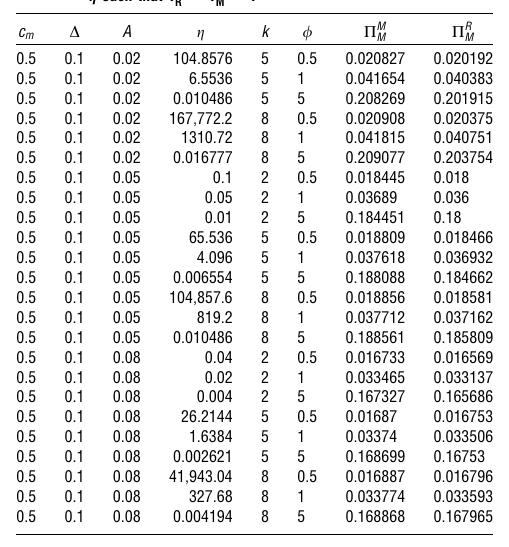
中文有趣的是,当 CL bðD AÞ2 8 时,制造商更喜欢管理收集。 在此范围内,零售商对 b 增加的销售反应较弱,因此,使用转移价格工具对于制造商来说并不那么有效。 他更喜欢只使用批发 表 3. 规模不经济对制造商在不解耦的情况下反向渠道选择的影响对于以下参数子集:cm = 0. 5,D = 0. 2,cm = 0. 1,A = {0. 2,0. 5,0. 8}D,k = {2,5,8},/ = {0.
OriginalWhen CL [ /ðD � AÞð1 � cm þ D � AÞ 4 , the retailer does not participate, and manufacturer-managed collection is optimal. We find that the retailer's collection rate is either 1 or 0 in equilibrium. s� R is 0 when CL � /ðD � AÞð1 � cm þ D � AÞ 4 , in which case retailer-managed collection is not an option for the manufacturer, and is 1 otherwise. This result shows that this cost structure fundamentally behaves in the same way as the economies of scale case analyzed in section 3.4.1.
中文5,1,5},g 值使得 s R = s M = 1 cm D A g k / PM M PR M 0. 5 0. 1 0. 02 104. 8576 5 0. 5 0. 020827 0. 020192 0. 5 0. 1 0. 02 6. 5536 5 1 0. 041654 0. 040383 0. 5 0. 1 0. 02 0. 010486 5 5 0. 208269 0. 201915 0.
OriginalIt also complements Savaşkan et al. (2004), who show that there is a range (CL � /ðD � AÞð1 � cm þ D � AÞ 8 when b � D) where retailermanaged collection is preferred by the manufacturer, and the sales volume and the collection rate are highest with retailer-managed collection. Our result shows that with no bound on b, the region where retailermanaged collection is more profitable becomes /ðD � AÞ2 8 � CL � /ðD � AÞð1 � cm þ D � AÞ 4 , and the retailer's collection rate need not be strictly higher than that under manufactureror the third-party-managed collection in equilibrium.
中文5 0. 1 0. 02 167,772. 28 0. 5 0. 020908 0. 020375 0. 5 0. 1 0. 02 1310. 72 8 1 0. 041815 0. 040751 0. 5 0. 1 0. 02 0. 016777 8 5 0. 209077 0. 203754 0. 5 0. 1 0. 05 0. 1 2 0. 5 0. 018445 0. 018 0. 5 0. 1 0. 05 0. 05 2 1 0. 03689 0. 036 0. 5 0. 1 0. 05 0. 01 2 5 0. 184451 0.
Page 7
OriginalThe effectiveness of retailermanaged collection in this case is due to what Savaşkan et al. (2004) dub the “scale effect” (the average collection cost Cðs; qÞ=qr ¼ CLs2 =qr decreases in the sales volume for a given collection rate τ), which parallels the effect of economies of scale discussed in section 3.4.1: The manufacturer offers the retailer a high transfer price (higher than D for large enough CL). Due to the scale effect, the retailer's response is to raise the sales volume, which has a sufficiently high positive effect to compensate the manufacturer's margin erosion from the high transfer price.
中文180. 5 0. 1 0. 05 65. 536 5 0. 5 0. 018809 0. 018466 0. 5 0. 1 0. 05 4. 096 5 1 0. 037618 0. 036932 0. 5 0. 1 0. 05 0. 006554 5 5 0. 188088 0. 184662 0. 5 0. 1 0. 05 104,857. 6 8 0. 5 0. 018856 0. 018581 0. 5 0. 1 0. 05 819. 2 8 1 0. 037712 0. 037162 0. 50. 1 0. 05 0. 010486 8 5 0.
OriginalInterestingly, when CL � bðD � AÞ2 8 , the manufacturer prefers to manage collection. In this range, the retailer's sales response to an increase in b is weaker, so using the transfer price tool is not as effective for the manufacturer. He prefers to use only the wholesale Table 3. The Impact of Diseconomies of Scale on the Manufacturer's Reverse Channel Choice Without Decoupling for the Following Parameter Subset: cm = 0.5, D = 0.2, cm = 0.1, A = {0.2,0.5,0.8}D, k = {2,5,8}, / = {0.5,1,5}, and Values of g such that s� R = s� M = 1 cm D A g k / PM M PR M 0.5 0.1 0.02 104.8576 5 0.5 0.020827 0.020192 0.5 0.1 0.02 6.5536 5 1 0.041654 0.040383 0.5 0.1 0.02 0.010486 5 5 0.208269 0.201915 0.5 0.1 0.02 167,772.2 8 0.5 0.020908 0.020375 0.5 0.1 0.02 1310.72 8 1 0.041815 0.040751 0.5 0.1 0.02 0.016777 8 5 0.209077 0.203754 0.5 0.1 0.05 0.1 2 0.5 0.018445 0.018 0.5 0.1 0.05 0.05 2 1 0.03689 0.036 0.5 0.1 0.05 0.01 2 5 0.184451 0.18 0.5 0.1 0.05 65.536 5 0.5 0.018809 0.018466 0.5 0.1 0.05 4.096 5 1 0.037618 0.036932 0.5 0.1 0.05 0.006554 5 5 0.188088 0.184662 0.5 0.1 0.05 104,857.6 8 0.5 0.018856 0.018581 0.5 0.1 0.05 819.2 8 1 0.037712 0.037162 0.5 0.1 0.05 0.010486 8 5 0.188561 0.185809 0.5 0.1 0.08 0.04 2 0.5 0.016733 0.016569 0.5 0.1 0.08 0.02 2 1 0.033465 0.033137 0.5 0.1 0.08 0.004 2 5 0.167327 0.165686 0.5 0.1 0.08 26.2144 5 0.5 0.01687 0.016753 0.5 0.1 0.08 1.6384 5 1 0.03374 0.033506 0.5 0.1 0.08 0.002621 5 5 0.168699 0.16753 0.5 0.1 0.08 41,943.04 8 0.5 0.016887 0.016796 0.5 0.1 0.08 327.68 8 1 0.033774 0.033593 0.5 0.1 0.08 0.004194 8 5 0.168868 0.167965 19375956, 2013, 5, Downloaded from https://onlinelibrary.wiley.com/doi/10.1111/j.1937-5956.2012.01426.x by Beijing University of Chemistry Technology, Wiley Online Library on [31/05/2026].
中文188561 0. 185809 0. 5 0. 1 0. 08 0. 04 2 0. 5 0. 016733 0. 016569 0. 5 0. 1 0. 08 0. 02 2 1 0. 033465 0. 033137 0. 5 0. 1 0. 08 0. 004 2 5 0. 167327 0. 165686 0. 5 0. 1 0. 08 26. 2144 5 0. 5 0. 01687 0. 016753 0. 5 0. 1 0. 081. 6384 5 1 0. 03374 0. 033506 0. 5 0. 1 0. 08 0. 002621 5 5 0. 168699 0. 16753 0. 5 0. 1 0. 08 41,943. 04 8 0. 5 0. 016887 0. 016796 0. 5 0. 1 0. 08 327. 68 8 1 0. 033774 0. 033593 0. 5 0. 1 0. 08 0. 004194 8 5 0. 168868 0. 167965 19375956, 2013,5、北京化学工业大学下载自https://onlinelibrary. wiley. com/doi/10. 1111/j. 1937-5956. 2012. 01426. x,Wiley 在线图书馆 [31/05/2026]。 有关使用规则,请参阅 Wiley 在线图书馆的条款和条件 (https://onlinelibrary. wiley. com/terms-and-conditions); OA 文章受适用的知识共享许可价格工具的约束,以影响零售额,且不会因收益渠道的双重边际化而产生损失。 这一结果体现了投资成本的规模效应和逆向物流的规模经济效应之间的区别成本:仅投资成本“规模效应”的存在不足以使零售商管理的集合变得最优;
OriginalSee the Terms and Conditions (https://onlinelibrary.wiley.com/terms-and-conditions) on Wiley Online Library for rules of use; OA articles are governed by the applicable Creative Commons License price tool to affect retail sales, and not incur losses due to double marginalization in the return channel. This result exhibits the distinction between the scale effect in the investment cost and the economies of scale effect in the reverse logistics cost: the existence of the investment cost “scale effect” alone is not enough to make retailer-managed collection optimal; it has to be strong enough.
中文它必须足够强大。 然而,如果 CL 太高 CL /ðD AÞð1 cm × D AÞ ,则收集的绝对成本太大,无法为零售商带来利润。 因此,制造商管理收集。 3. 6. 通用模型 前述分析得出的中心结果是,规模效应是确定最佳反向渠道选择的关键: 规模经济在逆向物流成本中,或者在投资成本中存在规模效应,足以激励零售商销售更多产品,制造商更愿意让零售商管理收货。 由于逆向物流成本存在规模不经济,或者投资成本规模效应较弱,他更喜欢管理收藏。 制造商从来不喜欢第三方管理的收集选项。
OriginalHowever, if CL is too high CL � /ðD � AÞð1 � cm þ D � AÞ � � , then the absolute cost of collection is too large for managing collection to be profitable for the retailer. Thus, the manufacturer manages collection. 3.6. The General Model The central result emerging from the preceding analysis is that scale effects are key in determining the optimal reverse channel choice: With economies of scale in the reverse logistics cost, or in the presence of a scale effect in the investment cost that sufficiently incentivizes the retailer to sell more, the manufacturer prefers to have the retailer manage collection.
中文我们的分析分别处理了逆向物流成本和投资成本。 由于其复杂结构,综合成本公式 Cðs; qÞ ¼ CLs2 þ gðsqÞk 与一般 k 不适合封闭形式的解决方案。 所以,我们进行了一项数值研究,比较制造商和零售商管理的系列; 第三方管理的收集选项始终以这些替代方案为主。 毫不奇怪,一般情况的解决方案是依赖于参数的; 最佳反向信道选择取决于 g、CL 和 k 的取值。 尽管如此,正如人们所预料的那样,最佳渠道选择取决于前面讨论的两种效应中哪一种占主导地位。 考虑图 3 中所示的示例。 在此示例中,投资成本的参数为0:3 CL 1。
OriginalWith diseconomies of scale in the reverse logistics cost, or a weak scale effect in the investment cost, he prefers to manage collection. The third-party-managed collection option is never preferred by the manufacturer. Our analysis treated the reverse logistics costs and investment costs separately. Due to its complicated structure, the combined cost formulation Cðs; qÞ ¼ CLs2 þ gðsqÞk with general k does not lend itself to closed-form solutions. Therefore, we carry out a numerical study that compares manufacturerand retailer-managed collection; the third-party-managed collection option is always dominated by these alternatives.
中文逆向物流成本表现出规模不经济,k = 3,g = 0. 3,0. 7,1。 对于这些参数,零售商和制造商分别管理的集合,如果逆向渠道成本仅由投资成本和逆向物流成本组成,则为最优,分别。 两种成本相结合的最佳收集渠道取决于哪种效应占主导地位。 如图所示,当逆向物流成分较小时(g较低),投资成本产生的规模效应占主导地位,零售商管理的收集是最优的(PR M [ PM M)。 随着 g 的增加,逆向物流成本开始占主导地位,对于越来越大的 CL 值范围,制造商管理的集合变得最佳。 我们的分析确定了决定制造商最佳反向渠道选择的三个关键因素:(i)逆向物流成本是否存在规模经济或不经济(k<1或>1);
OriginalNot surprisingly, the solution to the general case is parameter dependent; the optimal reverse channel choice depends on the values that g, CL, and k take. Nevertheless, as may be expected, the optimal channel choice is driven by which of the two previously discussed effects dominates. Consider the example presented in Figure 3. In this example, the investment cost has parameters 0:3 � CL � 1. The reverse logistics cost exhibits scale diseconomies with k = 3 and g = 0.3,0.7,1. For these parameters, retailerand manufacturer-managed collection, respectively, would be optimal if the reverse channel cost consisted only of investment cost and reverse logistics cost, respectively.
中文(ii)逆向物流成本的大小(g有多大); (iii) 投资成本的大小(CL 有多大)。 表 4 在一个简单的非正式框架中总结了它们的典型综合影响: 当逆向物流成本表现出规模经济(k < 1)时,逆向物流成本的影响与投资成本的典型影响是一致的。 两种作用相辅相成,创造强大的规模效应,使零售商管理的收集成为首选。 回想一下,如果投资成本的规模效应足够弱(CL 足够低),如果反向渠道成本仅由投资成本组成,则制造商管理的收集将是最佳的。 通过综合成本结构,逆向物流成本必须微不足道(g非常低)才能使这种效应持续存在,因此,制造商管理的收集被排除在 k < 1 列之外,因为这是一种非典型结果。
Page 9
OriginalIt is important to note that our analysis assumed that all parties face the same collection cost structure, no matter who manages collection. This assumption can hold in practice, because any party can outsource the reverse logistics activity and receive similar quotes from such providers. Nevertheless, it is possible that one party utilizes a different collection method and has a cost advantage over others in managing collection, particularly when utilizing his or her own resources for reverse logistics (e.g., a retailer who has proximity to consumers or a transporter who manages the reverse channel).
中文因此,关注反向渠道成本中的单位成本差异是一个效率陷阱,可能会导致制造商放弃利用正确的反向渠道选择来最大化其战略利益。 利润。 这项研究具有重要的管理意义。 这表明制造商确实可以将逆向渠道决策权传递给去中心化逆向供应链中的零售商,以提高其业务的盈利能力(即使零售商在收款方面没有成本优势)。 该选项的盈利能力取决于收集成本的结构,这是由其运营环境和产品的特征驱动的。 例如,考虑一家销售小型电子设备的消费电子产品制造商。
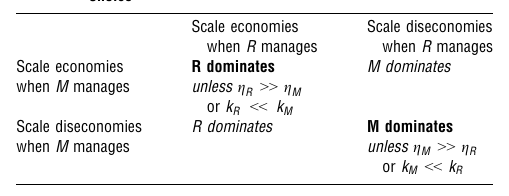
OriginalIf a party has a cost advantage, the scales can tip in favor of having that party manage collection. Proposition 4 in the Appendix shows that the manufacturer's equilibrium profits decrease in A, CL, k, and g in all three reverse channel configurations (M,R,3P). Hence, one can find thresholds on differentials between these parameters in different channels such that one channel is preferred over the other. Table 5 summarizes the implications of such possible cost structure differentials on the optimal reverse channel choice.
中文由于它们的尺寸,这些产品可以通过邮政网络收集(如 Drake 等人 2008 年的 Cycleon 示例)。 邮政合同规定数量折扣的,我们的结果表明,该制造商应该让零售商处理收集渠道的问题。 另一方面,电视生产商由于其产品的尺寸或数量,必须采用不同的收集策略,例如,收集代理必须直接从最终用户收集产品。 在这种情况下,逆向物流成本可能会表现出规模不经济,因为收集更多的旧产品可能需要到达更偏远的地点。 如果是这样,我们的结果表明,制造商最好管理收货(当然,除非零售商的收货成本远低于制造商)。
OriginalThe bold results in Table 5 follow our analysis using equal costs. The results in italics follow Proposition 4 and are intuitive: If retailer management dominates at equal cost, then clearly, if the scale effect under manufacturer management is not much stronger, is weaker, or even exhibits diseconomies of scale, then retailer management will continue to dominate. The 3P-managed case is not included because it is always dominated by manufacturer-managed collection at equal cost, and it is obvious that the result may be reversed if the 3P-managed case exhibits a sufficient cost advantage.
中文总而言之,虽然再制造本身可能是一个有吸引力的商业主张,但仔细管理反向渠道(通过让零售商承担责任并有效利用转让价格)可以增加销量产量和制造商的盈利能力。 我们模型的一个重要假设是新产品和再制造产品是完全可以替代的。 在实践中,许多再制造产品与新产品有所不同。 在支持信息的附录中,我们模拟了差异化再制造产品的案例。 我们的结果表明,我们发现了关于规模效应在确定适当的反向渠道方面的重要性的基本见解结构继续保持。 另一个假设是远期链有批发价合同。
OriginalHowever, a mere cost differential, be it with respect to collection or investment costs, is not sufficient to ensure such reversals. Table 5 The Impact of Cost Differentials on the Reverse Channel Choice Scale economies when R manages Scale diseconomies when R manages Scale economies R dominates M dominates when M manages unless gR >> gM or kR << kM Scale diseconomies R dominates M dominates when M manages unless gM >> gR or kM << kR 19375956, 2013, 5, Downloaded from https://onlinelibrary.wiley.com/doi/10.1111/j.1937-5956.2012.01426.x by Beijing University of Chemistry Technology, Wiley Online Library on [31/05/2026].
中文虽然批发价格合同是许多供应链(Lariviere 和Porteus 2001,Perakis 和 Roels 2007),研究正向链中的其他合同安排是否会改变制造商的最佳反向渠道选择将是很有趣的。 附录:可区分的新产品和再制造产品证明 1 号提案制造商管理的集合。 厂家管理收款时,零售商根据制造商报价的批发价 w 确定其销售价格 p,以最大化 PM R ðpÞ ¼ ðp wÞqðpÞ。 令 p(w) 表示零售商的最佳响应,q(w) 表示相应的销售数量。 很容易证明 p(w) = (1 + w)/2 和 q(w) = /(1 w)/2。
OriginalSee the Terms and Conditions (https://onlinelibrary.wiley.com/terms-and-conditions) on Wiley Online Library for rules of use; OA articles are governed by the applicable Creative Commons License The value of the strategic levers that a manufacturer can utilize to induce the retailers to sell more and the consequences of reverse channel revenue sharing requirements play an important role in the optimal reverse channel choice. Thus, focusing on unit cost differentials in reverse channel costs is an efficiency trap that may result in manufacturers foregoing the strategic benefits of utilizing the right reverse channel choice to maximize their profits.
中文制造商的目标是最大化 PM Mðw; sÞ ¼ ðw cm þ sDÞqðwÞ gðsqðwÞÞk AsqðwÞ: 制造商利润函数一阶条件的唯一解是 w ¼ ð1 þ cmÞ=2 和 s ¼ 4ðD A gk Þ1=ðk 1Þ /ð1 cmÞ : 但是,可以证明,当 k < 1 时,该解的 Hessian 行列式为负。 因此,这个驻点不能是制造商问题的最大化,对于制造商的问题,只有两种可能的解决方案:要么不收集任何东西,要么收集所有东西。 零售商管理的系列。 当零售商管理收货时,他确定销售价格 p 和回收率 τ 以使 PR Rðp 最大化;
OriginalThis research has important managerial implications. It shows that manufacturers can indeed pass the reverse channel decision rights to retailers in decentralized reverse supply chains to improve the profitability of their businesses (even if the retailer has no cost advantage in collection). The profitability of this option depends on the structure of the collection cost, which is driven by the characteristics of their operating environment and their products. For instance, consider a consumer electronics manufacturer that sells small electronic devices.
中文sÞ ¼ ðp wÞqðpÞ ðA bÞsqðpÞ gðsqðpÞÞk ;其中 b 是零售商从制造商处收到的每收集单位的付款。 令 p(w,b) 和 τ(w,b) 表示零售商的最佳响应,q(w,b) 表示相应的销售数量。 类似于制造商管理的收集场景,对于 pðw 的一阶条件存在唯一的解决方案; bÞ ¼ ð1 þ wÞ=2 ðwith qðw; bÞ ¼ /ð1 wÞ=2Þ 和 sðw; bÞ ¼ 2ðb A gk Þ1=ðk 1Þ /ð1 wÞ :生产和运营管理 22(5),第 1089–1102 页,(c) 2013 生产和运营管理学会 1097 19375956, 2013, 5,北京化学工业大学下载自https://onlinelibrary.
OriginalDue to their size, these products can be collected through postal networks (as in the Cycleon example of Drake et al. 2008). Where the postal contract specifies quantity discounts, our results suggest that this manufacturer should have the retailers deal with the collection channel. On the other hand, a TV producer, due to the size or volume of its products, would have to employ a different collection strategy, for example, the collecting agent would have to collect products directly from endusers.
中文wiley. com/doi/10. 1111/j. 1937-5956. 2012. 01426. x,Wiley 在线图书馆 [31/05/2026]。 有关使用规则,请参阅 Wiley 在线图书馆的条款和条件 (https://onlinelibrary.
Page 12
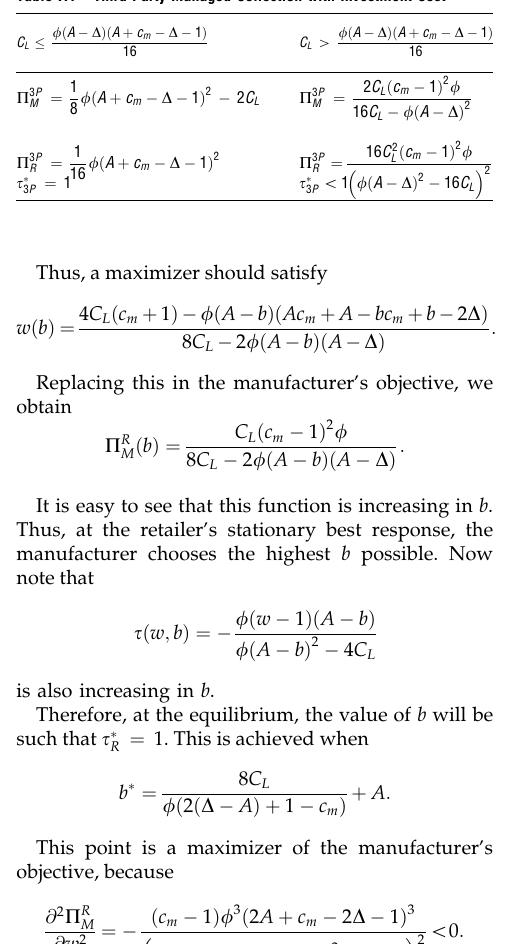
OriginalThus, the unique stationary point maximizes manufacturer profits when 8CL [ /ðA � DÞðA þ cm � D � 1Þ. The equilibrium profits of the manufacturer and the retailer are PM� M ¼ CLðcm � 1Þ2 / 8CL � /ðA � DÞ2 and PM� R ¼ 4C2 Lðcm � 1Þ2 / /ðA � DÞ2 � 8CL � �2 : When 8CL � /ðA � DÞðA þ cm � D � 1Þ, the interior solution obtained from the manufacturer's first order conditions is not a maximizer. In this case, the manufacturer's objective will be obtained at the boundaries. It is straightforward to show that the manufacturer's profit is maximized at s� M ¼ 1.
中文com/doi/10.
OriginalWhen sM ¼ 1, the manufacturer sets w ¼ 1þcmþA�D 2 . At this solution, the manufacturer obtains PM� M ¼ 1 /ðA þ cm � D � 1Þ2 � CL and the retailer obtains PM� R ¼ 1 16 /ðA þ cm � D � 1Þ2 . These results are summarized in Table A3. Third Party-Managed Collection. When the third party manages collection, the retailer's best response to the manufacturer's wholesale price w is pðwÞ ¼ 1þw 2 . The third party's objective is to maximize /s3P 2 ð�w � 1Þ þ 1 � � ðb � AÞ � CLs2 3P with respect to s3P.
中文1111/j. 1937-5956. 2012. 01426. x,Wiley 在线图书馆 [31/05/2026]。 有关使用规则,请参阅 Wiley 在线图书馆的条款和条件 (https://onlinelibrary. wiley. com/terms-and-conditions); OA 文章受适用的知识共享许可证管辖 替换并求解一阶条件给出唯一驻点 b ¼ A þ D 和 w ¼ /ðA DÞ2 8CLðcm þ 1Þ /ðA DÞ2 16CL : 当16CL [ /ðA DÞðA þ cm D 1Þ, s 3P \ 1。
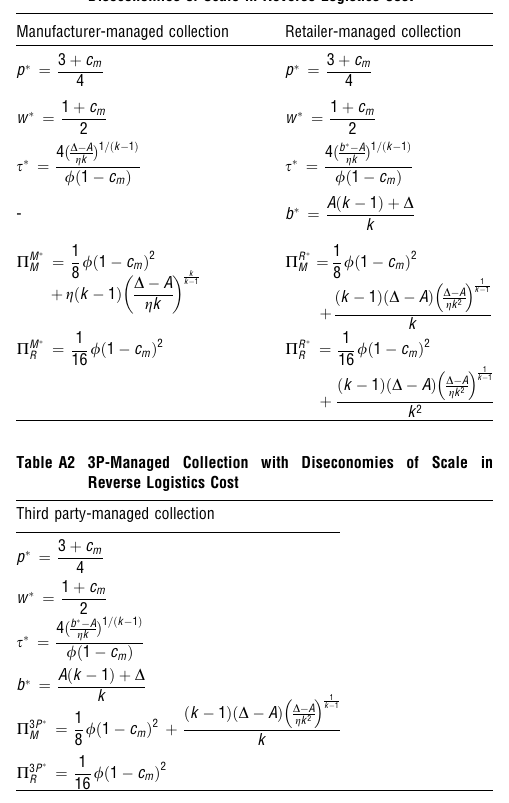
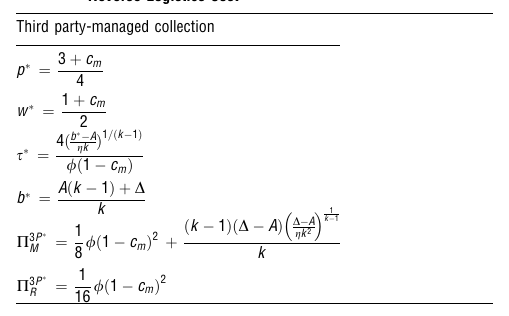
OriginalThis function is concave in s3P and is maximized at s� 3P ¼ /ðw�1ÞðA�bÞ 4CL for given w and b. Given the retailer's and the third party's best responses, the manufacturer's objective is to maximize PM M ¼ / 1 2 ð�w þ 1Þ � � ðsðD � AÞ � cm þ wÞ. Table A1 Manufacturerand Retailer-Managed Collection with Diseconomies of Scale in Reverse Logistics Cost Manufacturer-managed collection Retailer-managed collection p� ¼ 3 þ cm p� ¼ 3 þ cm w� ¼ 1 þ cm w� ¼ 1 þ cm s� ¼ 4ðD�A gk Þ1=ðk�1Þ /ð1 � cmÞ s� ¼ 4ðb� �A gk Þ1=ðk�1Þ /ð1 � cmÞ - b� ¼ Aðk � 1Þ þ D k PM� M ¼ /ð1 � cmÞ2 þ gðk � 1Þ D � A gk � � k k�1 PR� M ¼ /ð1 � cmÞ2 þ ðk � 1ÞðD � AÞ D�A gk2 � � 1 k�1 k PM� R ¼ /ð1 � cmÞ2 PR� R ¼ /ð1 � cmÞ2 þ ðk � 1ÞðD � AÞ D�A gk2 � � 1 k�1 k2 Table A2 3P-Managed Collection with Diseconomies of Scale in Reverse Logistics Cost Third party-managed collection p� ¼ 3 þ cm w� ¼ 1 þ cm s� ¼ 4ðb� �A gk Þ1=ðk�1Þ /ð1 � cmÞ b� ¼ Aðk � 1Þ þ D k P3P� M ¼ /ð1 � cmÞ2 þ ðk � 1ÞðD � AÞ D�A gk2 � � 1 k�1 k P3P� R ¼ /ð1 � cmÞ2 Table A3 Manufacturer-Managed Collection with Investment Cost CL � /ðA � DÞðA þ cm � D � 1Þ CL [ /ðA � DÞðA þ cm � D � 1Þ PM M ¼ /ðA þ cm � D � 1Þ2 � CL PM M ¼ CLðcm � 1Þ2 / 8CL � /ðA � DÞ2 PM R ¼ /ðA þ cm � D � 1Þ2 PM R ¼ 4C2 L ðcm � 1Þ2 / /ðA � DÞ2 � 8CL � �2 s� M ¼ 1 s� M \ 1 Production and Operations Management 22(5), pp.
中文另外,@2 PM 3P @w2 \ 0,以及 Hessian 行列式,/3 ðw 1Þ2 4CL / A2 þ AðD 3bÞ þ 3b2 3bD þ D2 16C2 L ; 在此驻点为正值。 因此,当 16CL [ /ðA DÞðA þ cm D 1Þ 时,制造商利润的唯一内部最大化是在 b ¼ A þ D 和 w ¼ /ðA DÞ2 8CLðcm þ 1Þ /ðA DÞ2 16CL 处获得的。 这此时制造商和零售商的均衡利润为 P3P M ¼ 2CLðcm 1Þ2 / 16CL /ðA DÞ2 和 P3P R ¼ 16C2 Lðcm 1Þ2 / /ðA DÞ2 16CL 2 : 虽然上面得到的平稳解是局部最大化,无法保证制造商目标相对于 b 和 w 的联合凹性,因此这不一定是全局最大化。 为了完整起见,我们还需要检查制造商的边界目标。 根据第三方的最佳回应,很容易看出:当b = A 时,s 3P ¼ 0。 在这种情况下•P3P M ¼ 1 8 /ð1 cmÞ2 和P3P R ¼ 1 16 /ð1 cmÞ2 s 3P ¼ 1 当b ¼ A + 8CL /ð1 cmþD AÞ 时。
Original1089–1102, (c) 2013 Production and Operations Management Society 1099 19375956, 2013, 5, Downloaded from https://onlinelibrary.wiley.com/doi/10.1111/j.1937-5956.2012.01426.x by Beijing University of Chemistry Technology, Wiley Online Library on [31/05/2026]. See the Terms and Conditions (https://onlinelibrary.wiley.com/terms-and-conditions) on Wiley Online Library for rules of use; OA articles are governed by the applicable Creative Commons License Substituting and solving the first-order conditions gives the unique stationary point b ¼ A þ D and w ¼ /ðA � DÞ2 � 8CLðcm þ 1Þ /ðA � DÞ2 � 16CL : When 16CL [ /ðA � DÞðA þ cm � D � 1Þ, s� 3P \ 1.
中文在这种情况下,•P3P M ¼ 1 8 /ðA × cm D 1Þ2 2CL 和 P3P R ¼ 1 16 /ðA × cm D 1Þ2 通过将制造商的内部最大化器与其边界解的目标进行比较,我们观察到,当 16CL [ /ðA DÞ ðA þ cm D 1Þ 时,内部解支配边界解。 否则,s 3P ¼ 1 的边界解占主导地位。 这些结果总结于表 A5 中。 零售商管理的系列。
OriginalAlso, @2 PM 3P @w2 \ 0, and the determinant of the Hessian, /3 ðw � 1Þ2 4CL � / A2 þ AðD � 3bÞ þ 3b2 � 3bD þ D2 � � � � 16C2 L ; is positive at this stationary point. Thus the only interior maximizer of manufacturer profit is obtained at b ¼ A þ D and w ¼ /ðA � DÞ2 � 8CLðcm þ 1Þ /ðA � DÞ2 � 16CL when 16CL [ /ðA � DÞðA þ cm � D � 1Þ. The equilibrium profits of the manufacturer and the retailer at this point are P3P M ¼ 2CLðcm � 1Þ2 / 16CL � /ðA � DÞ2 and P3P R ¼ 16C2 Lðcm � 1Þ2 / /ðA � DÞ2 � 16CL � �2 : Although the stationary solution obtained above is a local maximizer, the joint concavity of the manufacturer's objective with respect to b and w cannot be guaranteed, thus this is not necessarily a global maximizer.
中文零售商管理收货时,给定批发价w和转移价b,零售商最大化 PR R ¼ ð1 pÞ/ðsRðb AÞ þ p wÞ CLs2 R。 解决一阶条件会产生平稳最佳响应 sðw; bÞ ¼ /ðw 1ÞðA bÞ /ðA bÞ2 4CL 和 pðw; bÞ ¼ /ðA bÞ2 2CLðw þ 1Þ /ðA bÞ2 4CL :同样 @2 PR R @p2 \ 0,零售商 Hessian 的行列式是 /ð4CL /ðA bÞ2 Þ。 所以,目标不一定是 p 和 sR 共同凹的。 接下来,我们证明零售商的固定最佳响应将被迫达到边界,即 sR 1/4 1,由制造商。 让我们假设零售商的独特固定解决方案是局部最大化,并研究制造商对 w 和 b 的选择。
Page 14
OriginalIn this case PR M ¼ 1 8 /ð1 � cmÞ2 and PR R ¼ 1 16 /ð1 � cmÞ2 . Comparing the manufacturer profits at the two boundaries, we can fully characterize the manufacturer's decisions and the equilibrium as follows. When 4CL [ /ðA � DÞðA þ cm � D � 1Þ, PR Mðs� R ¼ 0Þ ¼ 1 8 /ð1 � cmÞ2 [ PR Mðs� R ¼ 1Þ ¼ 1 8ðcm � 1Þ/ð2A þ cm � 2D � 1Þ, and the equilibrium will take place at s� R ¼ 0. (Note that this condition also guarantees that the retailer will have positive profit at the equilibrium.) Otherwise, the equilibrium will take place at s� R ¼ 1.
中文第三方管理的收集渠道始终占据主导地位,因此未在此表中列出。 h 命题 4. 对于所有通道配置,制造商利润在 A、CL、g 和 k 方面都在下降。 因此,存在阈值 AM;R;3P, CLM;R;3P ,kM;R;3P 和 gM;R;3P 适用于所有通道配置,低于该值,制造商最好选择成本较低的参数方来管理反向通道。
OriginalThese results are summarized in Table A5. Comparison of Manufacturer Profits. Let us define CR L ¼ : /ðA � DÞðA þ cm � D � 1Þ ; CM L ¼ : /ðA � DÞðA þ cm � D � 1Þ and C3P L ¼ : /ðA � DÞðA þ cm � D � 1Þ : With some algebraic manipulation of the data in Tables A3, A4 and A5, Table A6 provides the ranking of manufacturer profits under manufacturerand retailer-managed collection for different parameter levels. The third party-managed collection channel is always dominated and therefore is not presented in this table. h PROPOSITION 4.
中文命题4的证明由包络定理,@P x Mðq; sÞ @y ¼ @Px M @y j q ;s ;其中 x = {M,R,3P} 且 y 是模型中的任何参数。 此外,表 A4 第三方管理的收藏(含投资成本) CL /ðA DÞðA þ cm D 1Þ CL [ /ðA DÞðA þ cm D 1Þ P3P M ¼ /ðA þ cm D 1Þ2 2CL P3P M ¼ 2CLðcm 1Þ2 / 16CL /ðA DÞ2 P3P R ¼ /ðA þ cm D 1Þ2P3P R ¼ 16C2 L ðcm 1Þ2 / /ðA DÞ2 16CL 2 s 3P ¼ 1 s 3P \ 1 生产和运营管理 22(5), 第 1089–1102, (c) 2013 年生产和运营管理协会 1101 19375956, 2013, 5,北京化学工业大学下载自https://onlinelibrary.
OriginalManufacturer profit is decreasing in A, CL, g, and k for all channel configurations. Hence, there exist thresholds AM;R;3P, CLM;R;3P , kM;R;3P and gM;R;3P for all channel configurations, below which the manufacturer is better off with the lower cost parameter party managing the reverse channel. Proof of Proposition 4 By the envelope theorem, @P�x Mðq; sÞ @y ¼ @Px M @y j q�;s� ; where x = {M,R,3P} and y is any parameter in the model. Furthermore, Table A4 Third Party-Managed Collection with Investment Cost CL � /ðA � DÞðA þ cm � D � 1Þ CL [ /ðA � DÞðA þ cm � D � 1Þ P3P M ¼ /ðA þ cm � D � 1Þ2 � 2CL P3P M ¼ 2CLðcm � 1Þ2 / 16CL � /ðA � DÞ2 P3P R ¼ /ðA þ cm � D � 1Þ2 P3P R ¼ 16C2 L ðcm � 1Þ2 / /ðA � DÞ2 � 16CL � �2 s� 3P ¼ 1 s� 3P \ 1 Production and Operations Management 22(5), pp.
中文wiley. com/doi/10. 1111/j. 1937-5956. 2012. 01426. x,Wiley 在线图书馆 [31/05/2026]。 有关使用规则,请参阅 Wiley 在线图书馆的条款和条件 (https://onlinelibrary.
Original1089–1102, (c) 2013 Production and Operations Management Society 1101 19375956, 2013, 5, Downloaded from https://onlinelibrary.wiley.com/doi/10.1111/j.1937-5956.2012.01426.x by Beijing University of Chemistry Technology, Wiley Online Library on [31/05/2026]. See the Terms and Conditions (https://onlinelibrary.wiley.com/terms-and-conditions) on Wiley Online Library for rules of use; OA articles are governed by the applicable Creative Commons License @Px M @y j q�;s� ¼ � @Cðq; sÞ @y j q�;s� for y ¼ fA; CL; g; kg because these parameters only come in via C(q,τ). It is straightforward to show that @Cðq; sÞ @CL j q�;s� ¼ s�2 � 0 since s 2 ½0; 1�: Similarly, @Cðq; sÞ @g j q�;s� ¼ q�k � 0 since q� � 0; @Cðq; sÞ @A j q�;s� ¼ q� � 0 since q� � 0; and @Cðq; sÞ @k j q�;s� ¼ kq�ðk�1Þ � 0 since q� � 0 and k [ 0: Therefore, ∀x ∈ {M,R,3P} and 8y 2 fA; CL; g; kg, @P�x M ðq;sÞ @y � 0. In other words, for any collection channel, the manufacturer's equilibrium profits are decreasing in A, CL, g and k.
中文wiley. com/terms-and-conditions); OA 文章受适用的知识共享许可 @Px M @y j q ;s ¼ @Cðq; sÞ @y j q ;s 为 y ¼ fA; CL;克; kg,因为这些参数仅通过 C(q,τ) 传入。 很容易表明@Cðq; sÞ @CL j q ; 从 s 2 ½0 开始,s ¼ s 2 0; 1:同样,@Cðq; sÞ @g j q ;s ¼ q k 0 自 q 0; @Cðq; sÞ @A j q ;s ¼ q 0 自 q 0;和@Cðq; sÞ @k j q ;s ¼ kq ðk 1Þ 0 因为 q 0 和 k [ 0: 因此,∀x ∈ {M,R,3P} 和 8y 2 fA; CL;克; kg, @P x M ðq;sÞ @y 0。 换句话说,对于任何收集渠道,制造商的均衡利润在 A、CL 中递减,g和k。 这个结果清楚地表明,当制造商以外的一方在收集方面具有足够大的优势时,即使成本相同,制造商管理的收集也不再是最佳选择。
OriginalThis result clearly indicates that when a party other than the manufacturer has a sufficiently large advantage in collection, manufacturer-managed collection is no longer optimal even if it was so at equal cost. As an example, consider a scenario with scale diseconomies where manufacturer-managed collection is optimal at equal costs, but some of the manufacturer's cost parameters are larger than that of the retailer. In this case, 9yM [ yR such that P�M M ðyM Þ \ P�R M ðyR Þ. In other words, there exists a sufficiently large cost differential between the costs of the manufacturer and the retailer, such that manufacturer preferences would be reversed.
中文举个例子,考虑一个规模不经济的场景,其中制造商管理的收集在同等成本下是最佳的,但有些制造商的成本参数比零售商的要大。 在这种情况下,9yM [ yR 使得 P M M ðyM Þ \ P R M ðyR Þ。 换句话说,制造商和零售商的成本之间存在足够大的成本差异,使得制造商的偏好发生逆转。 然而,值得注意的是,这个结果对于任何 yM [ yR 都不成立,反转需要足够大的差异 yM yR 。 注释 另请参阅 Guide 等。 (2003),Guide 和 Van Wassenhove (2001),Ferguson 和 Toktay (2006) 以及 Atasu 和 Souza (2012) 认为逆向物流成本可能表现出规模不经济。
OriginalHowever, it is important to note that this result does not hold for any yM [ yR , a sufficiently large difference yM � yR is required for the reversal. Notes See also Guide et al. (2003), Guide and Van Wassenhove (2001), Ferguson and Toktay (2006), and Atasu and Souza (2012), who argue that reverse logistics cost can exhibit diseconomies of scale. The parameter levels chosen are cm ¼ f0:2; 0:5; 0:8g, D ¼ f0:2cm; 0:5cm; 0:8cmg, A = {0.2D,0.5D,0.8D}, g = {0.01,0.1,1}, u = {0.5,1,5}, and k = {0.2,0.5,0.8}, and cover a broad range of possible outcomes.
中文选择的参数水平为 cm 1/4 f0:2; 0:5; 0:8g,直径 1/4 f0:2cm; 0:5厘米; 0:8cmg、A = {0. 2D,0. 5D,0. 8D}、g = {0. 01,0. 1,1}、u = {0. 5,1,5} 和 k = {0. 2,0. 5,0. 8},并涵盖广泛的可能结果。