Page 4
OriginalAnother way to calculate this complexity is to realize that the body of the first inner loop (for each ) is executed exactly times as each individual can be the member of at most one front and the second inner loop (for each ) can be executed at maximum times for each individual [each individual dominates individuals at maximum and each domination check requires at most comparisons] results in the overall computations.
中文计算这种复杂性的另一种方法是认识到第一个内部循环(对于每个 )的主体执行精确次数,因为每个个体最多可以是一个前端的成员,并且第二个内部循环(对于每个 )可以为每个个体执行最大次数[每个个体最多支配个体,每个支配检查最多需要比较]结果 在整体计算中。
OriginalIt is important to note that although the time complexity has reduced to , the storage requirement has increased to . Diversity Preservation We mentioned earlier that, along with convergence to the Pareto-optimal set, it is also desired that an EA maintains a good spread of solutions in the obtained set of solutions.
中文值得注意的是,虽然时间复杂度降低到 ,但存储需求却增加到 。 多样性保留 我们之前提到,除了收敛到帕累托最优集之外,还希望 EA 在获得的解集中保持解的良好分布。
OriginalThe original NSGA used the well-known sharing function approach, which has been found to maintain sustainable diversity in a population with appropriate setting of its associated parameters.
中文最初的 NSGA 使用了众所周知的共享函数方法,人们发现该方法可以通过适当设置相关参数来维持种群的可持续多样性。
OriginalThe sharing function method involves a sharing parameter , which sets the extent of sharing desired in a problem. This parameter is related to the distance metric chosen to calculate the proximity measure between two population members.
中文的 共享函数方法涉及共享参数,它设置问题中所需共享的程度。 该参数与选择用于计算两个群体成员之间的邻近度度量的距离度量相关。
OriginalThe parameter denotes the largest value of that distance metric within which any two solutions share each other's fitness. This parameter is usually set by the user, although there exist some guidelines [4].
中文该参数表示任意两个解共享彼此适应度的距离度量的最大值。 尽管存在一些指导原则,但该参数通常由用户设置[4]。
OriginalThere are two difficulties with this sharing function approach. 1) The performance of the sharing function method in maintaining a spread of solutions depends largely on the chosen value. - - - for each for each if then If dominates Add to the set of solutions dominated by else if then Increment the domination counter of if then belongs to the first front Initialize the front counter while Used to store the members of the next front for each for each if then belongs to the next front Authorized licensed use limited to: Beijing University of Chemical Technology.
中文这种共享函数方法有两个困难。 1)共享函数方法的性能 维持解决方案的分布很大程度上取决于所选择的值。 - - - foreach foreach if then If 主控 添加到 else if then 所主宰的解集合中 递增 if then 属于第一前置的主控计数器 初始化前置计数器 while 用于存储每个 if then 属于下前置的下前置成员 授权许可使用仅限于:北京化工大学。
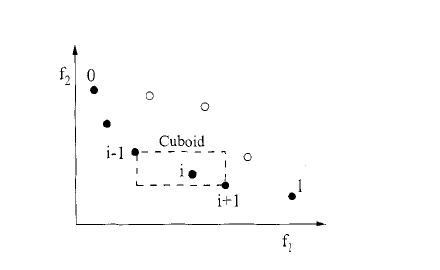
OriginalDownloaded on May 12,2026 at 10:49:15 UTC from IEEE Xplore. Restrictions apply. DEB et al.: A FAST AND ELITIST MULTIOBJECTIVE GA: NSGA-II 185 Fig. 1. Crowding-distance calculation.
中文于 2026 年 5 月 12 日 10:49:15 UTC 从 IEEE Xplore 下载。 存在限制。 DEB 等人:快速且精英的多目标 GA:NSGA-II 185 图 1。 拥挤距离计算。
OriginalPoints marked in filled circles are solutions of the same nondominated front. 2) Since each solution must be compared with all other solutions in the population, the overall complexity of the sharing function approach is .
中文用实心圆圈标记的点是同一非支配前沿的解。 2)由于每个解决方案都必须与所有其他解决方案进行比较,因此 在总体解决方案中,共享函数方法的总体复杂度为 。
OriginalIn the proposed NSGA-II, we replace the sharing function approach with a crowded-comparison approach that eliminates both the above difficulties to some extent. The new approach does not require any user-defined parameter for maintaining diversity among population members.
中文在提出的 NSGA-II 中,我们用拥挤比较方法取代了共享函数方法,在一定程度上消除了上述困难。 新方法不需要任何用户定义的参数来维持群体成员之间的多样性。
OriginalAlso, the suggested approach has a better computational complexity. To describe this approach, we first define a density-estimation metric and then present the crowded-comparison operator.
中文此外,建议的方法具有更好的计算复杂性。 为了描述这种方法,我们首先定义一个密度估计度量,然后 介绍拥挤比较运算符。
Original1) Density Estimation: To get an estimate of the density of solutions surrounding a particular solution in the population, we calculate the average distance of two points on either side of this point along each of the objectives.
中文1)密度估计:获得密度的估计 围绕总体中特定解决方案的解决方案,我们计算该点沿每个目标两侧的两点的平均距离。
OriginalThis quantity serves as an estimate of the perimeter of the cuboid formed by using the nearest neighbors as the vertices (call this the crowding distance). In Fig. 1, the crowding distance of the th solution in its front (marked with solid circles) is the average side length of the cuboid (shown with a dashed box).
中文该量可用作对使用最近邻居作为顶点形成的长方体周长的估计(称为拥挤距离)。 在图1中,第一个解在其前面(用实心圆圈标记)的拥挤距离是长方体的平均边长(用虚线框表示)。
OriginalThe crowding-distance computation requires sorting the population according to each objective function value in ascending order of magnitude. Thereafter, for each objective function, the boundary solutions (solutions with smallest and largest function values) are assigned an infinite distance value.
中文拥挤距离计算需要根据每个目标函数值以升序对总体进行排序。 此后,对于每个目标函数,边界解(具有最小和最大函数值的解)被分配无限距离值。
OriginalAll other intermediate solutions are assigned a distance value equal to the absolute normalized difference in the function values of two adjacent solutions. This calculation is continued with other objective functions.
中文所有其他中间解被分配一个距离值,该距离值等于两个相邻解的函数值的绝对归一化差。 此计算继续与其他目标 功能。
OriginalThe overall crowding-distance value is calculated as the sum of individual distance values corresponding to each objective. Each objective function is normalized before calculating the crowding distance.
中文总体拥挤距离值计算为与每个目标对应的各个距离值的总和。 在计算拥挤距离之前对每个目标函数进行归一化。
Page 6
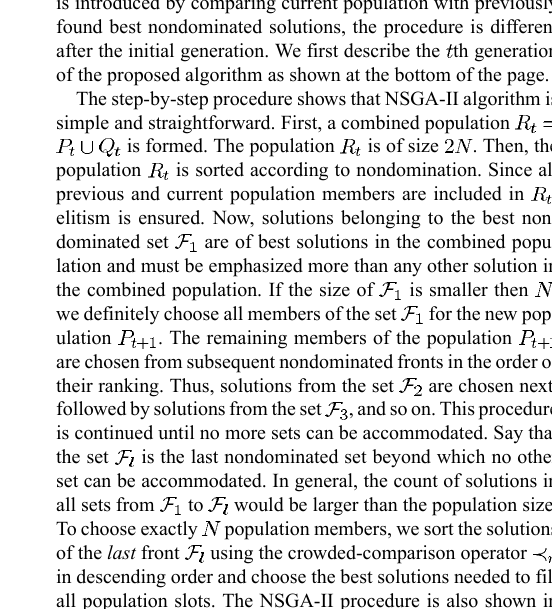
OriginalIn general, the count of solutions in all sets from to would be larger than the population size. To choose exactly population members, we sort the solutions of the last front using the crowded-comparison operator in descending order and choose the best solutions needed to fill all population slots.
中文一般来说,从 到 的所有集合中解决方案的数量将大于总体规模。 为了准确选择种群成员,我们使用拥挤比较运算符按降序对最后一个前沿的解决方案进行排序,并选择填充所有种群槽所需的最佳解决方案。
OriginalThe NSGA-II procedure is also shown in Fig. 2. The new population of size is now used for selection, crossover, and mutation to create a new population of size . It is important to note that we use a binary tournament selection operator but the selection criterion is now based on the crowded-comparison operator .
中文NSGA-II 流程也如图 2 所示。 现在,大小为 的新种群用于选择、交叉和突变,以创建大小为 的新种群。 值得注意的是,我们使用二元锦标赛选择运算符,但选择标准现在基于拥挤比较运算符 。
OriginalSince this operator requires both the rank and crowded distance of each solution in the population, we calculate these quantities while forming the population , as shown in the above algorithm.
中文由于该运算符需要 总体中每个解的排名和拥挤距离,我们在形成总体时计算这些量,如上面的算法所示。
OriginalConsider the complexity of one iteration of the entire algorithm. The basic operations and their worst-case complexities are as follows: 1) nondominated sorting is ; 2) crowding-distance assignment is ; 3) sorting on is .
中文考虑整个算法的一次迭代的复杂性。 基本操作及其最坏情况的复杂性如下: 1)非支配排序是; 2)拥挤距离分配为; 3) 排序依据是 。
OriginalThe overall complexity of the algorithm is , which is governed by the nondominated sorting part of the algorithm. If Fig. 2. NSGA-II procedure. performed carefully, the complete population of size need not be sorted according to nondomination.
中文算法的整体复杂度为 ,它由算法的非支配排序部分控制。 如果如图2。 NSGA-II 程序。如果仔细执行,则完整群体的大小不需要根据非支配性进行排序。
OriginalAs soon as the sorting procedure has found enough number of fronts to have members in , there is no reason to continue with the sorting procedure. The diversity among nondominated solutions is introduced by using the crowding comparison procedure, which is used in the tournament selection and during the population reduction phase.
中文一旦排序过程找到足够数量的前端来容纳 中的成员,就没有理由继续排序过程。 通过使用拥挤比较程序引入非支配解决方案之间的多样性,该程序用于锦标赛选择和人口减少阶段。
OriginalSince solutions compete with their crowding-distance (a measure of density of solutions in the neighborhood), no extra niching parameter (such as needed in the NSGA) is required.
中文由于解决方案与其拥挤距离(邻近解决方案密度的度量)竞争,因此不需要额外的利基参数(例如 NSGA 中所需的参数)。
OriginalAlthough the crowding distance is calculated in the objective function space, it can also be implemented in the parameter space, if so desired [3]. However, in all simulations performed in this study, we have used the objective-function space niching.
中文虽然拥挤距离是在目标函数空间中计算的,但如果需要的话,也可以在参数空间中实现[3]。 然而,在所有模拟中 在本研究中,我们使用了目标函数空间利基。
Page 7
OriginalSIMULATION RESULTS In this section, we first describe the test problems used to compare the performance of NSGA-II with PAES and SPEA. For PAES and SPEA, we have identical parameter settings as suggested in the original studies.
中文仿真结果 在本节中,我们首先描述用于比较 NSGA-II 与 PAES 和 SPEA 性能的测试问题。 对于 PAES 和 SPEA,我们具有与原始研究中建议的相同的参数设置。
OriginalFor NSGA-II, we have chosen a reasonable set of values and have not made any effort in finding the best parameter setting. We leave this task for a future study. combine parent and offspring population - - - all nondominated fronts of and until until the parent population is filled - - calculate crowding-distance in include th nondominated front in the parent pop check the next front for inclusion Sort sort in descending order using choose the first elements of - - use selection, crossover and mutation to create a new population increment the generation counter Authorized licensed use limited to: Beijing University of Chemical Technology.
中文对于 NSGA-II,我们选择了一组合理的值,并且没有做出任何努力来寻找最佳参数设置。 我们把这个任务留到以后的研究。 合并父代和子代种群 - - - 的所有非支配前沿,直到父代种群填满 - - 计算拥挤距离,将非支配前沿包含在父代人口中,检查下一个前沿是否包含 使用选择的第一个元素按降序排序 - - 使用选择、交叉和变异创建新的种群 增量计数器 授权许可使用仅限于:北京化工大学。
OriginalDownloaded on May 12,2026 at 10:49:15 UTC from IEEE Xplore. Restrictions apply. DEB et al.: A FAST AND ELITIST MULTIOBJECTIVE GA: NSGA-II 187 TABLE I TEST PROBLEMS USED IN THIS STUDY All objective functions are to be minimized.
中文于 2026 年 5 月 12 日 10:49:15 UTC 从 IEEE Xplore 下载。 存在限制。 DEB 等人:快速且精英的多目标 GA:NSGA-II 187 表 I 本研究中使用的测试问题 所有目标函数都将被最小化。
OriginalTest Problems We first describe the test problems used to compare different MOEAs. Test problems are chosen from a number of significant past studies in this area. Veldhuizen [22] cited a number of test problems that have been used in the past.
中文测试问题 我们首先描述用于比较不同 MOEA 的测试问题。 测试问题选自该领域过去的许多重要研究。 Veldhuizen [22] 引用了一些过去使用过的测试问题。
OriginalOf them, we choose four problems: Schaffer's study (SCH) [19], Fonseca and Fleming's study (FON) [10], Poloni's study (POL) [16], and Kursawe's study (KUR) [15]. In 1999, the first author suggested a systematic way of developing test problems for multiobjective optimization [3].
中文其中,我们选择四个问题:Schaffer 的研究(SCH)[19],Fonseca 和 Fleming 的研究(FON)[10],Poloni 的研究(POL)[16],以及 Kursawe 的研究(KUR)[15]。 1999 年,第一作者提出了一种开发多目标优化测试问题的系统方法 [3]。
OriginalZitzler et al. [25] followed those guidelines and suggested six test problems. We choose five of those six problems here and call them ZDT1, ZDT2, ZDT3, ZDT4, and ZDT6. All problems have two objective functions.
中文齐茨勒等人。 [25]遵循这些指南并提出了六个测试问题。 我们在这里选择这六个问题中的五个,并将它们称为 ZDT1、ZDT2、ZDT3、ZDT4 和 ZDT6。 所有问题都有两个目标函数。
OriginalNone of these problems have any constraint. We describe these problems in Table I. The table also shows the number of variables, their bounds, the Pareto-optimal solutions, and the nature of the Pareto-optimal front for each problem.
中文这些问题都没有任何限制。 我们在表 I 中描述了这些问题。 该表还显示了变量的数量、它们的界限、帕累托最优解以及问题的性质 每个问题的帕累托最优前沿。
OriginalAll approaches are run for a maximum of 25 000 function evaluations. We use the single-point crossover and bitwise mutation for binary-coded GAs and the simulated binary crossover (SBX) operator and polynomial mutation [6] for real-coded GAs.
中文所有方法最多运行 25000 次函数评估。 我们对二进制编码的 GA 使用单点交叉和按位变异,对实数编码的 GA 使用模拟二元交叉 (SBX) 算子和多项式变异 [6]。
OriginalThe crossover probability of and a mutation probability of or (where is the number of decision variables for real-coded GAs and is the string length for binary-coded GAs) are used.
中文使用 的交叉概率和 或 的变异概率(其中 是实数编码 GA 的决策变量数量,是二进制编码 GA 的字符串长度)。
OriginalFor real-coded NSGA-II, we use distribution indexes [6] for crossover and mutation operators as and , respectively. The population obtained at the end of 250 generations (the population after elite-preserving operator is applied) is used to calculate a couple of performance metrics, which we discuss in the next section.
中文对于实数编码的 NSGA-II,我们使用分布索引 [6] 进行交叉和 变异算子分别为 和 。 在 250 代结束时获得的种群(应用精英保留算子后的种群)用于计算几个性能指标,我们将在下一节中讨论。
OriginalFor PAES, we use a depth value equal to four and an archive size of 100. We use all population members of the archive obtained at the end of 25 000 iterations to calculate the performance metrics.
中文对于 PAES,我们使用等于 4 的深度值和 100 的存档大小。 我们使用 25000 次迭代结束时获得的存档的所有总体成员来计算性能指标。
OriginalFor SPEA, we use a population of size 80 and an external population of size 20 (this 4 : 1 ratio is suggested by the developers of SPEA to maintain an adequate selection pressure for the elite solutions), so that overall population size becomes 100.
中文对于 SPEA,我们使用规模为 80 的总体和规模为 20 的外部总体(这 SPEA的开发者建议采用4:1的比例来维持 为精英解决方案提供足够的选择压力),使总体人口规模变为 100。
OriginalSPEA is also run until 25 000 function evaluations are done. For SPEA, we use the Authorized licensed use limited to: Beijing University of Chemical Technology. Downloaded on May 12,2026 at 10:49:15 UTC from IEEE Xplore.
中文SPEA 也会运行到 已完成 25 000 次功能评估。对于 SPEA,我们使用 授权许可使用仅限于:北京化工大学。 于 2026 年 5 月 12 日 10:49:15 UTC 从 IEEE Xplore 下载。
OriginalRestrictions apply.
中文存在限制。
Original188 IEEE TRANSACTIONS ON EVOLUTIONARY COMPUTATION, VOL. 6, NO. 2, APRIL 2002
中文188 IEEE 进化计算交易,卷。 6、没有。 2、2002 年 4 月
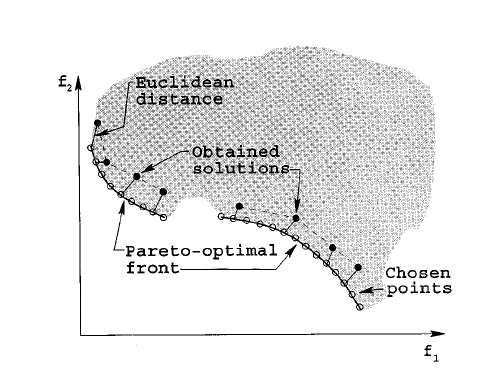
OriginalFig. 3. Distance metric 7. nondominated solutions of the combined GA and external populations at the final generation to calculate the performance metrics used in this study.
中文图 3. 距离度量 7. 最后一代的组合 GA 和外部种群的非支配解,用于计算本研究中使用的性能度量。
OriginalFor PAES, SPEA, and binary-coded NSGA-II, we have used 30 bits to code each decision variable. Performance Measures Unlike in single-objective optimization, there are two goals in a multiobjective optimization: 1) convergence to the Pareto-optimal set and 2) maintenance of diversity in solutions of the Pareto-optimal set.
中文对于 PAES、SPEA 和二进制编码的 NSGA-II,我们使用 30 位来编码每个决策变量。 性能测量与单目标优化不同,多目标优化有两个目标:1)收敛到帕累托最优集,2)维持帕累托最优集解的多样性。
OriginalThese two tasks cannot be measured adequately with one performance metric. Many performance metrics have been suggested [1], [8], [24]. Here, we define two performance metrics that are more direct in evaluating each of the above two goals in a solution set obtained by a multiobjective optimization algorithm.
中文这两项任务无法用一种绩效指标来充分衡量。 已经提出了许多性能指标[1]、[8]、[24]。 在这里,我们定义了两个性能指标,可以更直接地评估多目标获得的解决方案集中的上述两个目标 优化算法。
OriginalThe first metric measures the extent of convergence to a known set of Pareto-optimal solutions. Since multiobjective algorithms would be tested on problems having a known set of Pareto-optimal solutions, the calculation of this metric is possible.
中文第一个指标衡量一组已知的帕累托最优解的收敛程度。 由于多目标算法将在具有一组已知的帕累托最优解的问题上进行测试,因此该度量的计算是可能的。
Page 10
OriginalThe fixed archive strategy of PAES allows better convergence to be achieved in two out of nine problems. Table III shows the mean and variance of the diversity metric obtained using all three algorithms.
中文PAES 的固定存档策略可以在九个问题中的两个上实现更好的收敛。 表 III 显示了使用所有三种算法获得的多样性度量的平均值和方差。
OriginalNSGA-II (real or binary coded) performs the best in all nine test problems. The worst performance is observed with PAES. For illustration, we show one of the ten runs of PAES with an arbitrary run of NSGA-II (real-coded) on problem SCH in Fig. 5.
中文NSGA-II(实数或二进制编码)在所有九个测试问题中表现最好。 PAES 的性能最差。 为了便于说明,我们在图 5 中展示了 10 次 PAES 运行之一以及对问题 SCH 的任意 NSGA-II(实数编码)运行。
OriginalOn most problems, real-coded NSGA-II is able to find a better spread of solutions than any other algorithm, including binary-coded NSGA-II. In order to demonstrate the working of these algorithms, we also show typical simulation results of PAES, SPEA, and NSGA-II on the test problems KUR, ZDT2, ZDT4, and ZDT6.
中文在大多数问题上,实数编码 NSGA-II 能够比任何其他算法(包括二进制编码 NSGA-II)找到更好的解决方案。 为了演示这些算法的工作原理,我们还展示了 PAES、SPEA 和 NSGA-II 在测试问题 KUR、ZDT2、ZDT4 和 ZDT6 上的典型仿真结果。
OriginalThe problem KUR has three discontinuous regions in the Pareto-optimal front. Fig. 6 shows all nondominated solutions obtained after 250 generations with NSGA-II (real-coded).
中文问题 KUR 在帕累托最优前沿具有三个不连续区域。 图 6 显示了 NSGA-II(实数编码)250 代后获得的所有非支配解。
OriginalThe Pareto-optimal region is also shown in the figure. This figure demonstrates the abilities of NSGA-II in converging to the true front and in finding diverse solutions in the front.
中文图中还显示了帕累托最优区域。 该图展示了 NSGA-II 收敛到真实前沿以及在前沿寻找多样化解决方案的能力。
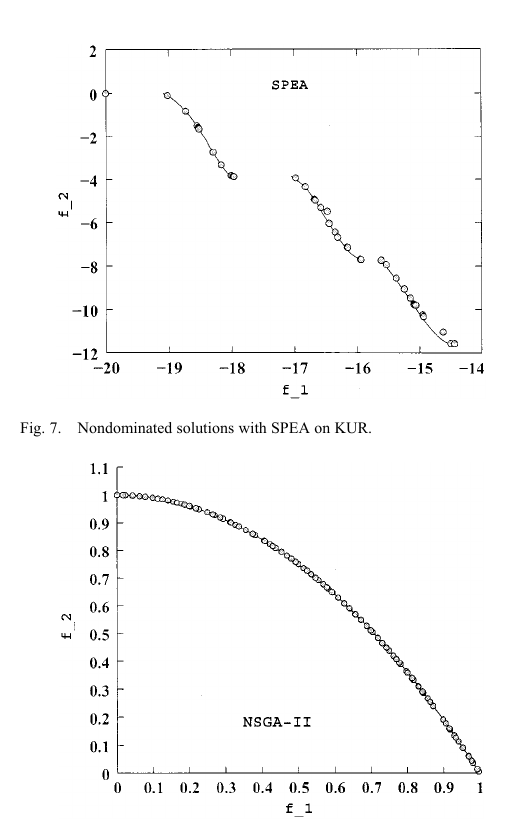
OriginalFig. 7 shows the obtained nondominated solutions with SPEA, which is the next-best algorithm for this problem (refer to Tables II and III). Fig. 5. NSGA-II finds better spread of solutions than PAES on SCH.
中文图7所示 使用 SPEA 获得的非支配解,这是该问题的次优算法(参见表 II 和表 III)。 图 5. NSGA-II 在 SCH 上发现了比 PAES 更好的解决方案传播。
OriginalFig. 6. Nondominated solutions with NSGA-II (real-coded) on KUR. Authorized licensed use limited to: Beijing University of Chemical Technology. Downloaded on May 12,2026 at 10:49:15 UTC from IEEE Xplore.
中文图 6. KUR 上的 NSGA-II(实数编码)非支配解决方案。 授权许可使用仅限于:北京化工大学。 于 2026 年 5 月 12 日 10:49:15 UTC 从 IEEE Xplore 下载。
OriginalRestrictions apply.
中文存在限制。
Page 11
Original190 IEEE TRANSACTIONS ON EVOLUTIONARY COMPUTATION, VOL. 6, NO. 2, APRIL 2002
中文190 IEEE 进化计算交易,卷。 6、没有。 2、2002 年 4 月
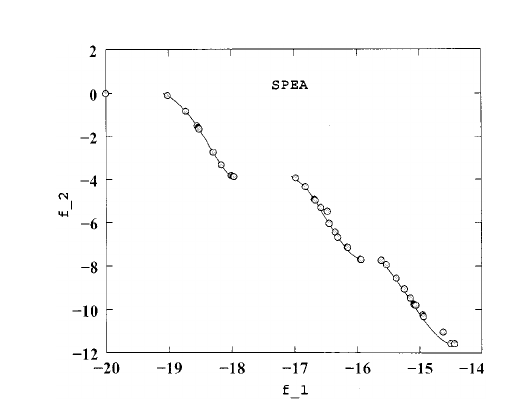
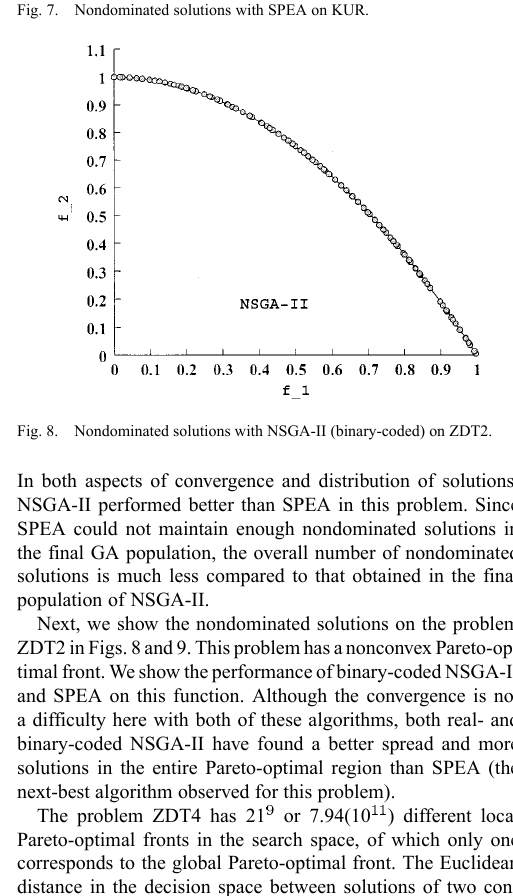
OriginalFig. 7. Nondominated solutions with SPEA on KUR. Fig. 8. Nondominated solutions with NSGA-II (binary-coded) on ZDT2. In both aspects of convergence and distribution of solutions, NSGA-II performed better than SPEA in this problem.
中文图 7. KUR 上 SPEA 的非支配解决方案。 图 8. ZDT2 上使用 NSGA-II(二进制编码)的非支配解决方案。 在该问题中,NSGA-II 在解的收敛性和分布性方面均优于 SPEA。
OriginalSince SPEA could not maintain enough nondominated solutions in the final GA population, the overall number of nondominated solutions is much less compared to that obtained in the final population of NSGA-II.
中文由于 SPEA 无法在最终 GA 种群中维持足够的非支配解,因此与 NSGA-II 最终种群中获得的非支配解总数相比要少得多。
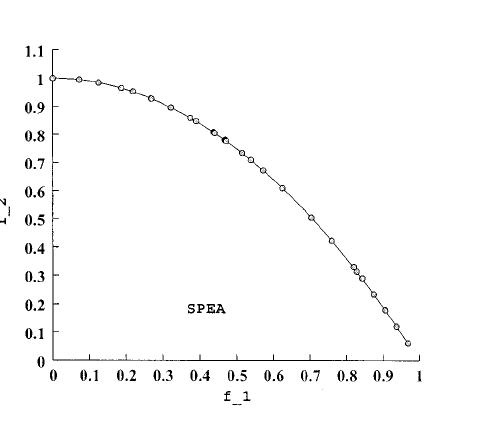
OriginalNext, we show the nondominated solutions on the problem ZDT2 in Figs. 8 and 9. This problem has a nonconvex Pareto-optimal front. We show the performance of binary-coded NSGA-II and SPEA on this function.
中文接下来,我们展示图 2 和 3 中问题 ZDT2 的非支配解。 8和9。 该问题具有非凸帕累托最优前沿。 我们展示了二进制编码 NSGA-II 和 SPEA 在此函数上的性能。
OriginalAlthough the convergence is not a difficulty here with both of these algorithms, both realand binary-coded NSGA-II have found a better spread and more solutions in the entire Pareto-optimal region than SPEA (the next-best algorithm observed for this problem).
中文虽然这两种算法的收敛都不是困难,但实数编码和二进制编码的 NSGA-II 都在整个 Pareto 最优区域中找到了比 SPEA(针对此问题观察到的下一个最佳算法)更好的分布和更多的解决方案。
OriginalThe problem ZDT4 has 21 or 7.94(10 ) different local Pareto-optimal fronts in the search space, of which only one corresponds to the global Pareto-optimal front. The Euclidean distance in the decision space between solutions of two consecutive local Pareto-optimal sets is 0.25.
中文问题 ZDT4 在搜索空间中有 21 个或 7.94(10 ) 个不同的局部帕累托最优前沿,其中只有一个对应于全局帕累托最优前沿。 两个连续局部帕累托最优集的解之间的决策空间中的欧几里得距离为 0.25。
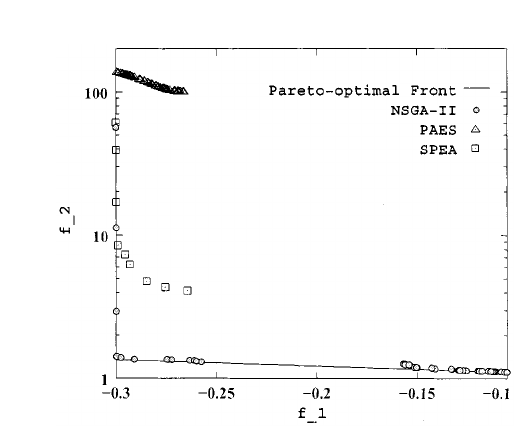
OriginalFig. 10 shows that both real-coded NSGA-II and PAES get stuck at different local Pareto-optimal sets, but the convergence and ability to find a diverse set of solutions are definitely better with NSGA-II.
中文图 10 显示实数编码的 NSGA-II 和 PAES 都陷入了不同的局部帕累托最优集,但 NSGA-II 的收敛性和找到不同解决方案集的能力肯定更好。
OriginalBinary-coded GAs have difficulties in converging Fig. 9. Nondominated solutions with SPEA on ZDT2. Fig. 10. NSGA-II finds better convergence and spread of solutions than PAES on ZDT4. near the global Pareto-optimal front, a matter that is also been observed in previous single-objective studies [5].
中文二进制编码的 GA 难以收敛 图 9. ZDT2 上 SPEA 的非支配解。 图 10. NSGA-II 在 ZDT4 上发现了比 PAES 更好的收敛性和扩展性。接近全球帕累托最优前沿,这一问题在之前的单目标研究中也观察到过[5]。
OriginalOn a similar ten-variable Rastrigin's function [the function here], that study clearly showed that a population of size of about at least 500 is needed for single-objective binary-coded GAs (with tournament selection, single-point crossover and bitwise mutation) to find the global optimum solution in more than 50% of the simulation runs. Since we have used a population of size 100, it is not expected that a multiobjective GA would find the global Pareto-optimal solution, but NSGA-II is able to find a good spread of solutions even at a local Pareto-optimal front.
中文在类似的十变量 Rastrigin 函数 [此处的函数] 上,该研究清楚地表明,单目标二进制编码 GA(具有锦标赛选择、单点交叉和按位)需要至少 500 人左右的群体 突变)来找到超过的全局最优解 50% 的模拟运行。由于我们使用了人口 大小为 100,预计多目标 GA 不会找到全局 Pareto 最优解,但 NSGA-II 即使在局部 Pareto 最优前沿也能够找到良好的解散布。
OriginalSince SPEA converges poorly on this problem (see Table II), we do not show SPEA results on this figure. Finally, Fig. 11 shows that SPEA finds a better converged set of nondominated solutions in ZDT6 compared to any other algorithm.
中文由于 SPEA 在这个问题上的收敛性很差(见表 II),因此我们没有在此图中显示 SPEA 结果。 最后,图 11 显示,与任何其他算法相比,SPEA 在 ZDT6 中找到了一组更好的收敛非支配解。
OriginalHowever, the distribution in solutions is better with real-coded NSGA-II. Different Parameter Settings In this study, we do not make any serious attempt to find the best parameter setting for NSGA-II.
中文然而,使用实数编码的 NSGA-II 解的分布更好。 不同的参数设置在本研究中,我们没有认真尝试寻找 NSGA-II 的最佳参数设置。
Page 13
OriginalBut in this section, we perAuthorized licensed use limited to: Beijing University of Chemical Technology. Downloaded on May 12,2026 at 10:49:15 UTC from IEEE Xplore. Restrictions apply.
中文但在本节中,我们的授权许可使用仅限于:北京化工大学。 于 2026 年 5 月 12 日 10:49:15 UTC 从 IEEE Xplore 下载。 存在限制。
OriginalDEB et al.: A FAST AND ELITIST MULTIOBJECTIVE GA: NSGA-II 191 Fig. 11. Real-coded NSGA-II finds better spread of solutions than SPEA on ZDT6, but SPEA has a better convergence.
中文DEB 等人:快速且精英的多目标 GA:NSGA-II 191 图 11。 实数编码 NSGA-II 在 ZDT6 上发现比 SPEA 更好的解扩展,但 SPEA 具有更好的收敛性。
OriginalTABLE IV MEAN AND VARIANCE OF THE CONVERGENCE AND DIVERSITY METRICS UP TO 500 GENERATIONS form additional experiments to show the effect of a couple of different parameter settings on the performance of NSGA-II.
中文表 IV 最多 500 代的收敛性和多样性度量的均值和方差形成了额外的实验,以显示几个不同的参数设置对 NSGA-II 性能的影响。
OriginalFirst, we keep all other parameters as before, but increase the number of maximum generations to 500 (instead of 250 used before). Table IV shows the convergence and diversity metrics for problems POL, KUR, ZDT3, ZDT4, and ZDT6.
中文首先,我们保留以前的所有其他参数,但将最大代数增加到 500(而不是之前使用的 250)。 表 IV 显示了问题 POL、KUR、ZDT3、ZDT4 和 ZDT6 的收敛性和多样性度量。
OriginalNow, we achieve a convergence very close to the true Pareto-optimal front and with a much better distribution. The table shows that in all these difficult problems, the real-coded NSGA-II has converged very close to the true optimal front, except in ZDT6, which probably requires a different parameter setting with NSGA-II.
中文现在,我们实现了非常接近真正的帕累托最优前沿的收敛,并且具有更好的分布。 该表显示,在所有这些难题中,实编码的 NSGA-II 都非常接近真正的最优前沿,但 ZDT6 除外,ZDT6 可能需要与 NSGA-II 不同的参数设置。
OriginalParticularly, the results on ZDT3 and ZDT4 improve with generation number. The problem ZDT4 has a number of local Pareto-optimal fronts, each corresponding to particular value of .
中文帕特别是,ZDT3 和 ZDT4 的结果随着代数的增加而提高。 问题 ZDT4 有许多局部帕累托最优前沿,每个前沿都对应于 的特定值。
OriginalA large change in the decision vector is needed to get out of a local optimum. Unless mutation or crossover operators are capable of creating solutions in the basin of another better attractor, the improvement in the convergence toward the true Pareto-optimal front is not possible.
中文需要对决策向量进行较大改变才能摆脱局部最优。 除非突变或交叉算子能够在另一个更好的吸引子盆地中创建解决方案,否则不可能改进向真正的帕累托最优前沿的收敛。
OriginalWe use NSGA-II (real-coded) with a smaller distribution index for mutation, which has an effect of creating solutions with more spread than before. Rest of the parameter settings are identical as before.
中文我们使用具有较小分布指数的 NSGA-II(实数编码)进行突变,其具有 创建比以前更广泛的解决方案的效果。 其余参数设置与之前相同。
OriginalThe convergence metric and diversity measure on problem ZDT4 at the end of 250 generations are as follows: Fig. 12. Obtained nondominated solutions with NSGA-II on problem ZDT4.
中文问题ZDT4在250代结束时的收敛性度量和多样性度量如下:图12。 使用 NSGA-II 在问题 ZDT4 上获得非支配解。
OriginalThese results are much better than PAES and SPEA, as shown in Table II. To demonstrate the convergence and spread of solutions, we plot the nondominated solutions of one of the runs after 250 generations in Fig. 12.
中文这些结果比 PAES 和 SPEA 好得多,如表 II 所示。 为了证明解的收敛和传播,我们在图 12 中绘制了 250 代后其中一次运行的非支配解。
OriginalThe figure shows that NSGA-II is able to find solutions on the true Pareto-optimal front with . ROTATED PROBLEMS It has been discussed in an earlier study [3] that interactions among decision variables can introduce another level of difficulty to any multiobjective optimization algorithm including EAs.
中文该图显示 NSGA-II 能够在真正的帕累托最优前沿找到 的解。 旋转问题 在早期的研究 [3] 中已经讨论过,决策变量之间的相互作用可能会给包括 EA 在内的任何多目标优化算法带来另一个难度。
OriginalIn this section, we create one such problem and investigate the working of previously three MOEAs on the following epistatic problem: minimize minimize where and for (2) An EA works with the decision variable vector , but the above objective functions are defined in terms of the variable vector , which is calculated by transforming the decision variable vector by a fixed rotation matrix .
中文在本节中,我们创建一个这样的问题,并研究之前三个 MOEA 在以下上位问题上的工作情况:最小化 最小化 其中 和 for (2) EA 使用决策变量向量 ,但上述目标函数是根据变量向量 定义的, 它是通过将决策变量向量通过固定的旋转矩阵进行变换来计算的。
OriginalThis way, the objective functions are functions of a linear combination of decision variables. In order to maintain a spread of solutions over the Pareto-optimal region or even converge to any particular solution requires an EA to update all decision variables in a particular fashion.
中文这样,目标函数就是决策变量的线性组合的函数。 为了保持解决方案在帕累托最优区域的分布,甚至收敛到任何特定解决方案,需要 EA 以特定方式更新所有决策变量。
OriginalWith a generic search operator, such as the variablewise SBX operator used here, this becomes a difficult task for an EA. However, here, we are interested in evaluating the overall behavior of three elitist MOEAs.
中文对于通用搜索运算符(例如此处使用的可变 SBX 运算符),这对于 EA 来说是一项艰巨的任务。 然而, 在这里,我们有兴趣评估三个精英 MOEA 的整体行为。
OriginalWe use a population size of 100 and run each algorithm until 500 generations. For SBX, we use and we use for mutation. To restrict the Pareto-optimal solutions to lie Authorized licensed use limited to: Beijing University of Chemical Technology.
中文我们使用 100 的总体规模并运行每个算法,直到 500代。对于SBX,我们使用并且我们使用 用于突变。 限制帕累托最优解为谎言 授权许可使用仅限于:北京化工大学。
OriginalDownloaded on May 12,2026 at 10:49:15 UTC from IEEE Xplore. Restrictions apply.
中文于 2026 年 5 月 12 日 10:49:15 UTC 从 IEEE Xplore 下载。 存在限制。
Original192 IEEE TRANSACTIONS ON EVOLUTIONARY COMPUTATION, VOL. 6, NO. 2, APRIL 2002
中文192 IEEE 进化计算交易,卷。 6、没有。 2、2002 年 4 月
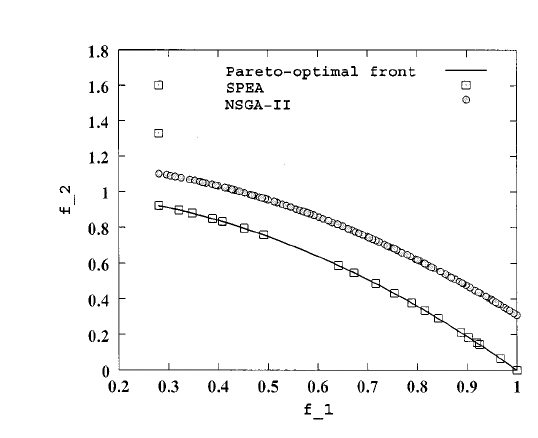
OriginalFig. 13. Obtained nondominated solutions with NSGA-II, PAES, and SPEA on the rotated problem. within the prescribed variable bounds, we discourage solutions with by adding a fixed large penalty to both objectives.
中文图13。 使用 NSGA-II、PAES 和 SPEA 获得旋转问题的非支配解。在规定的变量范围内,我们通过为两个目标添加固定的大惩罚来阻止解决方案。
OriginalFig. 13 shows the obtained solutions at the end of 500 generations using NSGA-II, PAES, and SPEA. It is observed that NSGA-II solutions are closer to the true front compared to solutions obtained by PAES and SPEA.
中文图 13 显示了使用 NSGA-II、PAES 和 SPEA 在 500 代结束时获得的解决方案。 可以看出,与 PAES 和 SPEA 获得的解决方案相比,NSGA-II 解决方案更接近真实前沿。
OriginalThe correlated parameter updates needed to progress toward the Pareto-optimal front makes this kind of problems difficult to solve. NSGA-II's elite-preserving operator along with the real-coded crossover and mutation operators is able to find some solutions close to the Pareto-optimal front [with resulting ].
中文走向帕累托最优所需的相关参数更新 前端使得这类问题很难解决。 NSGA-II 的精英保留算子以及实数编码的交叉和变异算子能够找到一些接近帕累托最优前沿的解决方案[结果]。
OriginalThis example problem demonstrates that one of the known difficulties (the linkage problem [11], [12]) of single-objective optimization algorithm can also cause difficulties in a multiobjective problem.
中文该示例问题表明,单目标优化算法的已知困难之一(联动问题[11]、[12])也可能导致多目标问题出现困难。
OriginalHowever, more systematic studies are needed to amply address the linkage issue in multiobjective optimization.
中文然而,需要更系统的研究来充分解决多目标优化中的联动问题。
OriginalCONSTRAINT HANDLING In the past, the first author and his students implemented a penalty-parameterless constraint-handling approach for singleobjective optimization. Those studies [2], [6] have shown how a tournament selection based algorithm can be used to handle constraints in a population approach much better than a number of other existing constraint-handling approaches.
中文约束处理过去,第一作者和他的学生实现了一种用于单目标优化的惩罚无参数约束处理方法。 这些研究 [2]、[6] 已经展示了如何使用基于锦标赛选择的算法来处理总体方法中的约束,其效果比许多其他现有的约束处理方法要好得多。
OriginalA similar approach can be introduced with the above NSGA-II for solving constrained multiobjective optimization problems. Proposed Constraint-Handling Approach (Constrained NSGA-II) This constraint-handling method uses the binary tournament selection, where two solutions are picked from the population and the better solution is chosen.
中文上述 NSGA-II 可以引入类似的方法来解决约束多目标优化问题。 提出的约束处理方法(受约束的 NSGA-II) 该约束处理方法使用二元锦标赛选择,其中从总体中挑选两个解决方案,并选择更好的解决方案。
OriginalIn the presence of constraints, each solution can be either feasible or infeasible. Thus, there may be at most three situations: 1) both solutions are feasible; 2) one is feasible and other is not; and 3) both are infeasible.
中文在存在约束的情况下,每个解决方案都可以是可行的或不可行的。 因此,最多可能存在三种情况:1)两种方案都可行; 2)一种可行,另一种不可行; 3) 两者都不可行。
OriginalFor single objective optimization, we used a simple rule for each case. Case 1) Choose the solution with better objective function value. Case 2) Choose the feasible solution.
中文对于单一目标优化,我们针对每种情况使用了一个简单的规则。 情况1)选择目标函数值较好的解。 情况2)选择可行的解决方案。
OriginalCase 3) Choose the solution with smaller overall constraint violation. Since in no case constraints and objective function values are compared with each other, there is no need of having any penalty parameter, a matter that makes the proposed constraint-handling approach useful and attractive.
中文情况3)选择总体约束违规较小的解决方案。 由于在任何情况下约束和目标函数值都不会相互比较,因此不需要任何惩罚参数,这使得所提出的约束处理方法有用且有吸引力。
OriginalIn the context of multiobjective optimization, the latter two cases can be used as they are and the first case can be resolved by using the crowded-comparison operator as before.
中文在多目标优化的背景下,后两种情况可以按原样使用,第一种情况可以像以前一样使用拥挤比较算子来解决。
OriginalTo maintain the modularity in the procedures of NSGA-II, we simply modify the definition of domination between two solutions and . Definition 1: A solution is said to constrained-dominate a solution , if any of the following conditions is true.
中文为了保持 NSGA-II 程序中的模块化,我们只需修改两个解 和 之间的支配定义。 定义 1:如果满足以下任一条件,则称该解为受约束支配解 。
Original1) Solution is feasible and solution is not. 2) Solutions and are both infeasible, but solution has a smaller overall constraint violation. 3) Solutions and are feasible and solution dominates solution .
中文1)解可行,解不可行。 2) 解 和 均不可行,但解有 较小的整体约束违规。 3) 解 和 是可行的且解占主导地位 解决方案。
OriginalThe effect of using this constrained-domination principle is that any feasible solution has a better nondomination rank than any infeasible solution. All feasible solutions are ranked according to their nondomination level based on the objective function values.
中文使用这种约束支配原则的效果是,任何可行的解决方案都比任何不可行的解决方案具有更好的非支配等级。 所有可行的解决方案根据目标函数值根据其非支配级别进行排序。
OriginalHowever, among two infeasible solutions, the solution with a smaller constraint violation has a better rank. Moreover, this modification in the nondomination principle does not change the computational complexity of NSGA-II.
中文然而,在两个不可行解中,约束违反较小的解具有更好的排名。 而且,这种对非支配原则的修改并没有改变NSGA-II的计算复杂度。
OriginalThe rest of the NSGA-II procedure as described earlier can be used as usual. The above constrained-domination definition is similar to that suggested by Fonseca and Fleming [9].
中文前面描述的 NSGA-II 程序的其余部分可以照常使用。 上述约束支配定义与 Fonseca 和 Fleming [9] 提出的定义类似。
OriginalThe only difference is in the way domination is defined for the infeasible solutions. In the above definition, an infeasible solution having a larger overall constraint-violation are classified as members of a larger nondomination level.
中文唯一的区别在于为不可行的解决方案定义支配的方式。 在上述定义中,具有较大总体约束违反的不可行解被分类为较大非支配级别的成员。
OriginalOn the other hand, in [9], infeasible solutions violating different constraints are classified as members of the same nondominated front. Thus, one infeasible solution violating a constraint marginally will be placed in the same nondominated level with another solution violating a different constraint to a large extent.
中文另一方面,在[9]中,违反不同约束的不可行解被归类为同一非支配阵线的成员。 因此,一个稍微违反约束的不可行解将与另一个很大程度上违反不同约束的解置于相同的非支配级别。
OriginalThis may cause an algorithm to wander in the infeasible search region for more generations before reaching the feasible region through constraint boundaries. Moreover, since Fonseca–Fleming's approach requires domination checks with the constraint-violation values, the proposed approach of this paper is computationally less expensive and is simpler.
中文这可能会导致算法 在通过约束边界到达可行区域之前,在不可行搜索区域中徘徊更多代。 此外,由于丰塞卡-弗莱明的方法需要对违反约束的值进行支配检查,因此本文提出的方法在计算上更便宜并且更简单。
OriginalRay–Tai–Seow's Constraint-Handling Approach Ray et al. [17] suggested a more elaborate constraint-handling technique, where constraint violations of all constraints are not simply summed together.
中文Ray–Tai–Seow 的约束处理方法 Ray 等人。 [17]提出了一种更复杂的约束处理技术,其中所有约束的约束违规并不是简单地总结在一起。
OriginalInstead, a nondomination check of constraint violations is also made. We give an outline of this procedure here. Authorized licensed use limited to: Beijing University of Chemical Technology.
中文相反,还会对约束违规进行非支配检查。 我们在此概述此过程。 授权许可使用仅限于:北京化工大学。
OriginalDownloaded on May 12,2026 at 10:49:15 UTC from IEEE Xplore. Restrictions apply. DEB et al.: A FAST AND ELITIST MULTIOBJECTIVE GA: NSGA-II 193 TABLE V CONSTRAINED TEST PROBLEMS USED IN THIS STUDY All objective functions are to be minimized.
中文于 2026 年 5 月 12 日 10:49:15 UTC 从 IEEE Xplore 下载。 存在限制。 DEB 等人:快速且精英的多目标 GA:NSGA-II 193 本研究中使用的表 V 约束测试问题 所有目标函数均应最小化。
OriginalThree different nondominated rankings of the population are first performed. The first ranking is performed using objective function values and the resulting ranking is stored in a -dimensional vector .
中文首先对总体进行三种不同的非支配排序。 使用目标函数值执行第一次排序,并将所得排序存储在 维向量 中。
Page 15
OriginalWe choose this rather large number of generations to investigate if the spread in solutions Authorized licensed use limited to: Beijing University of Chemical Technology.
中文我们选择这个相当大的代数来调查解决方案的传播授权许可使用是否仅限于:北京化工大学。
OriginalDownloaded on May 12,2026 at 10:49:15 UTC from IEEE Xplore. Restrictions apply.
中文于 2026 年 5 月 12 日 10:49:15 UTC 从 IEEE Xplore 下载。 存在限制。
Original194 IEEE TRANSACTIONS ON EVOLUTIONARY COMPUTATION, VOL. 6, NO. 2, APRIL 2002
中文194 IEEE 进化计算交易,卷。 6、没有。 2、2002 年 4 月
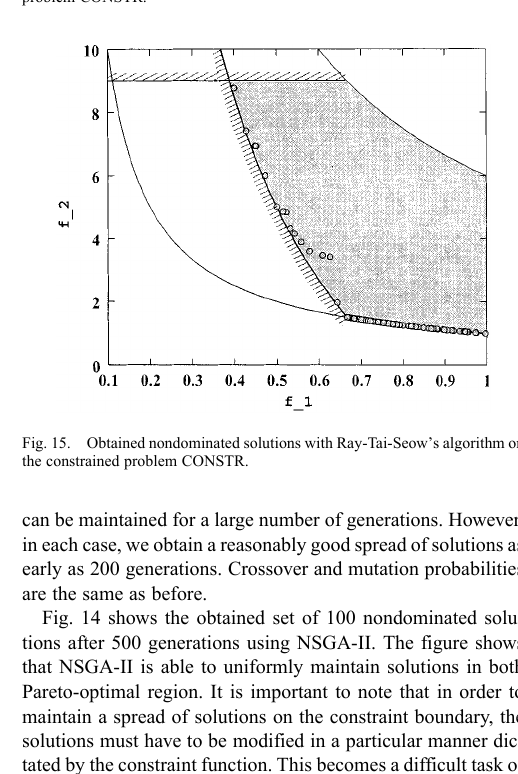
OriginalFig. 14. Obtained nondominated solutions with NSGA-II on the constrained problem CONSTR. Fig. 15. Obtained nondominated solutions with Ray-Tai-Seow's algorithm on the constrained problem CONSTR.
中文图14。 使用 NSGA-II 在约束问题 CONSTR 上获得非支配解。 图 15. 利用 Ray-Tai-Seow 算法对约束问题 CONSTR 获得非支配解。
Originalcan be maintained for a large number of generations. However, in each case, we obtain a reasonably good spread of solutions as early as 200 generations. Crossover and mutation probabilities are the same as before.
中文可以维持很多代。 然而,在每种情况下,我们早在 200 代就获得了相当好的解决方案传播。 交叉和变异概率与以前相同。
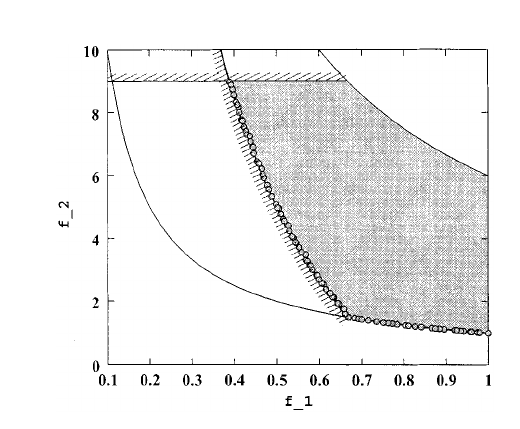
OriginalFig. 14 shows the obtained set of 100 nondominated solutions after 500 generations using NSGA-II. The figure shows that NSGA-II is able to uniformly maintain solutions in both Pareto-optimal region.
中文图 14 显示了使用 NSGA-II 进行 500 代后获得的 100 个非支配解集。 该图表明 NSGA-II 能够在两个 Pareto 最优区域中一致地维持解。
OriginalIt is important to note that in order to maintain a spread of solutions on the constraint boundary, the solutions must have to be modified in a particular manner dictated by the constraint function.
中文值得注意的是,为了在约束边界上保持解的扩展,解必须以约束函数规定的特定方式进行修改。
OriginalThis becomes a difficult task of any search operator. Fig. 15 shows the obtained solutions using Ray-Tai-Seow's algorithm after 500 generations. It is clear that NSGA-II performs better than Ray–Tai–Seow's algorithm in terms of converging to the true Pareto-optimal front and also in terms of maintaining a diverse population of nondominated solutions.
中文这对任何搜索操作员来说都是一项艰巨的任务。 图 15 显示了使用 Ray-Tai-Seow 算法经过 500 代后获得的解。 很明显, NSGA-II 在收敛到真正的帕累托最优前沿以及维持非支配解的多样化群体方面比 Ray–Tai–Seow 算法表现得更好。
OriginalNext, we consider the test problem SRN. Fig. 16 shows the nondominated solutions after 500 generations using NSGA-II. Fig. 16. Obtained nondominated solutions with NSGA-II on the constrained problem SRN.
中文接下来,我们考虑测试问题SRN。 图 16 显示了使用 NSGA-II 500 代后的非支配解。 图 16. 使用 NSGA-II 在约束问题 SRN 上获得非支配解。
OriginalFig. 17. Obtained nondominated solutions with Ray–Tai–Seow's algorithm on the constrained problem SRN. The figure shows how NSGA-II can bring a random population on the Pareto-optimal front.
中文图 17. 使用 Ray–Tai–Seow 算法在约束问题 SRN 上获得非支配解。 该图显示了 NSGA-II 如何将随机群体带到帕累托最优前沿。
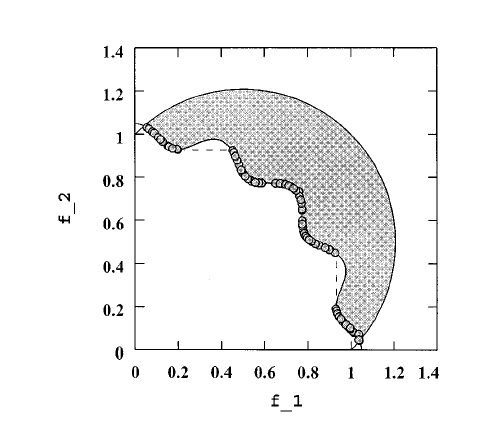
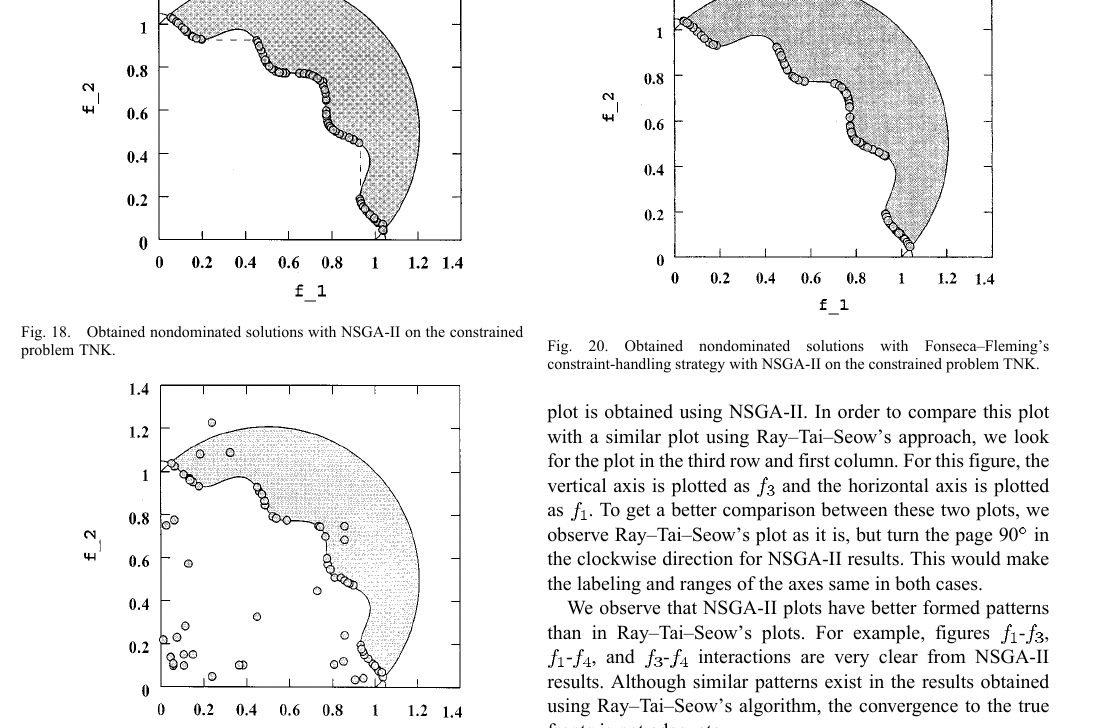
OriginalRay–Tai–Seow's algorithm is also able to come close to the front on this test problem (Fig. 17). Figs. 18 and 19 show the feasible objective space and the obtained nondominated solutions with NSGA-II and Ray–Tai–Seow's algorithm.
中文Ray–Tai–Seow 的算法在这个测试问题上也能够接近领先(图 17)。 无花果。 图 18 和 19 显示了可行的目标空间以及使用 NSGA-II 和 Ray–Tai–Seow 算法获得的非支配解。
Page 16
OriginalHere, the Pareto-optimal region is discontinuous and NSGA-II does not have any difficulty in finding a wide spread of solutions over the true Pareto-optimal region. Although Ray–Tai–Seow's algorithm found a number of solutions on the Pareto-optimal front, there exist many infeasible solutions even after 500 generations.
中文这里,帕累托最优区域是不连续的,并且 NSGA-II 在真正的帕累托最优区域上找到广泛的解决方案没有任何困难。 尽管Ray-Tai-Seow的算法在Pareto最优前沿找到了许多解,但即使在500代之后仍然存在许多不可行的解。
OriginalIn order to demonstrate the working of Fonseca–Fleming's constraint-handling strategy, we implement it with NSGA-II and apply on TNK. Fig. 20 shows 100 population members at the end of 500 generations and with identical parameter setting as used in Fig. 18.
中文为了证明丰塞卡-弗莱明的约束汉-的工作原理 DL策略,我们用NSGA-II来实现,并应用在TNK上。 图 20 显示了 100 名人口成员 500 代,参数设置与中使用的相同 图 18.
OriginalBoth these figures demonstrate that the proposed and Fonseca–Fleming's constraint-handling strategies work well with NSGA-II. Authorized licensed use limited to: Beijing University of Chemical Technology.
中文这两个图都表明,所提出的约束处理策略和 Fonseca-Fleming 的约束处理策略与 NSGA-II 配合良好。 授权许可使用仅限于:北京化工大学。
OriginalDownloaded on May 12,2026 at 10:49:15 UTC from IEEE Xplore. Restrictions apply. DEB et al.: A FAST AND ELITIST MULTIOBJECTIVE GA: NSGA-II 195 Fig. 18. Obtained nondominated solutions with NSGA-II on the constrained problem TNK.
中文于 2026 年 5 月 12 日 10:49:15 UTC 从 IEEE Xplore 下载。 存在限制。 DEB 等人:快速且精英的多目标 GA:NSGA-II 195 图 18。 使用 NSGA-II 在约束问题 TNK 上获得非支配解。
OriginalFig. 19. Obtained nondominated solutions with Ray–Tai–Seow's algorithm on the constrained problem TNK. Ray et al. [17] have used the problem WATER in their study. They normalized the objective functions in the following manner: Since there are five objective functions in the problem WATER, we observe the range of the normalized objective function values of the obtained nondominated solutions.
中文图 19. 利用 Ray–Tai–Seow 算法对约束问题 TNK 获得非支配解。 雷等人。 [17]在他们的研究中使用了水问题。 他们通过以下方式对目标函数进行归一化:由于问题 WATER 中有五个目标函数,我们观察所获得的非支配解的归一化目标函数值的范围。
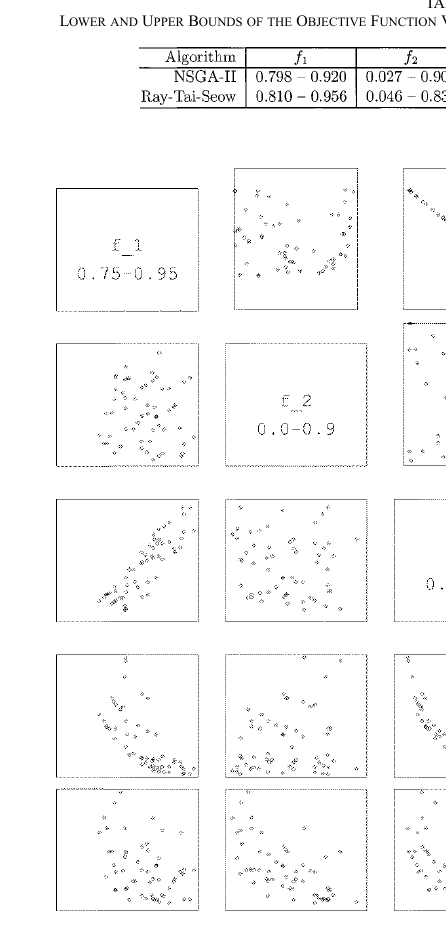
OriginalTable VI shows the comparison with Ray–Tai–Seow's algorithm. In most objective functions, NSGA-II has found a better spread of solutions than Ray–Tai–Seow's approach. In order to show the pairwise interactions among these five normalized objective functions, we plot all or ten interactions in Fig. 21 for both algorithms.
中文表六显示了与 Ray–Tai–Seow 算法的比较。 在大多数目标函数中,NSGA-II 发现了比 Ray-Tai-Seow 方法更好的解决方案。 为了显示这五个归一化目标之间的成对相互作用 对于这两种算法,我们在图 21 中绘制了所有或十个交互作用。
OriginalNSGA-II results are shown in the upper diagonal portion of the figure and the Ray–Tai–Seow's results are shown in the lower diagonal portion. The axes of any plot can be obtained by looking at the corresponding diagonal boxes and their ranges.
中文NSGA-II 结果显示在图的上对角部分,Ray-Tai-Seow 的结果显示在下对角部分。 任何图的轴都可以通过查看相应的对角线框及其范围来获得。
OriginalFor example, the plot at the first row and third column has its vertical axis as and horizontal axis as . Since this plot belongs in the upper side of the diagonal, this Fig. 20.
中文例如,第一行第三列的图的纵轴为 ,横轴为 。 由于该图属于对角线的上侧,因此图 20.
OriginalObtained nondominated solutions with Fonseca–Fleming's constraint-handling strategy with NSGA-II on the constrained problem TNK. plot is obtained using NSGA-II. In order to compare this plot with a similar plot using Ray–Tai–Seow's approach, we look for the plot in the third row and first column.
中文利用 NSGA-II 的 Fonseca-Fleming 约束处理策略在约束问题 TNK 上获得非支配解。 图是使用 NSGA-II 获得的。 为了将此图与使用 Ray–Tai–Seow 方法的类似图进行比较,我们在第三行和第一列中查找该图。
OriginalFor this figure, the vertical axis is plotted as and the horizontal axis is plotted as . To get a better comparison between these two plots, we observe Ray–Tai–Seow's plot as it is, but turn the page 90 in the clockwise direction for NSGA-II results.
中文对于该图,垂直轴绘制为 ,水平轴绘制为 。 为了更好地比较这两个图,我们按原样观察 Ray-Tai-Seow 的图,但将 NSGA-II 结果顺时针方向翻到第 90 页。
OriginalThis would make the labeling and ranges of the axes same in both cases. We observe that NSGA-II plots have better formed patterns than in Ray–Tai–Seow's plots. For example, figures - , - , and - interactions are very clear from NSGA-II
中文这将使两种情况下轴的标签和范围相同。 我们观察到 NSGA-II 图比 Ray-Tai-Seow 图具有更好的形成模式。 例如,NSGA-II 中的数字 - 、 - 和 - 交互作用非常清晰
Originalresults. Although similar patterns exist in the results obtained
中文结果。尽管获得的结果中存在类似的模式
Originalusing Ray–Tai–Seow's algorithm, the convergence to the true fronts is not adequate.
中文使用 Ray-Tai-Seow 算法,无法充分收敛到真实前沿。
OriginalCONCLUSION We have proposed a computationally fast and elitist MOEA based on a nondominated sorting approach.
中文结论 我们提出了一种基于非支配排序方法的计算快速且精英的 MOEA。
OriginalOn nine different difficult test problems borrowed from the literature, the proposed NSGA-II was able to maintain a better spread of solutions and converge better in the obtained nondominated front compared to two other elitist MOEAs—PAES and SPEA.
中文在从文献中借用的九个不同的困难测试问题上,与其他两种精英主义 MOEA(PAES 和 SPEA)相比,所提出的 NSGA-II 能够保持更好的解分布,并在获得的非支配前沿更好地收敛。
OriginalHowever, one problem, PAES, was able to converge closer to the true Pareto-optimal front. PAES maintains diversity among solutions by controlling crowding of solutions in a deterministic and prespecified number of equal-sized cells in the search space.
中文然而,有一个问题,PAES,能够收敛到更接近真实的情况。 帕累托最优前沿。 PAES 通过控制搜索空间中确定性且预先指定数量的相等大小单元中的解决方案拥挤来保持解决方案之间的多样性。
OriginalIn that problem, it is suspected that such a deterministic crowding coupled with the effect of mutation-based approach has been beneficial in converging near the true front compared to the dynamic and parameterless crowding approach used in NSGA-II and SPEA.
中文在该问题中,与 NSGA-II 和 SPEA 中使用的动态无参数拥挤方法相比,我们怀疑这种确定性拥挤加上基于突变的方法的效果有利于在真实前沿附近收敛。
OriginalHowever, the diversity preserving mechanism used in NSGA-II is found to be the best among the three approaches studied here. On a problem having strong parameter interactions, NSGA-II has been able to come closer to the true front than the other two approaches, but the important matter is that all three approaches faced difficulties in solving this so-called highly epistatic problem.
中文然而,NSGA-II 中使用的多样性保留机制被发现是三种方法中最好的 在这里学习。 在参数交互作用较强的问题上,NSGA-II 能够比其他两种方法更接近真实前沿,但重要的是,这三种方法在解决这个所谓的高度上位问题时都面临困难。
OriginalAlthough this has been a matter of ongoing Authorized licensed use limited to: Beijing University of Chemical Technology. Downloaded on May 12,2026 at 10:49:15 UTC from IEEE Xplore.
中文尽管这是一个持续的问题,授权许可使用仅限于:北京化工大学。 于 2026 年 5 月 12 日 10:49:15 UTC 从 IEEE Xplore 下载。
OriginalRestrictions apply.
中文存在限制。
Original196 IEEE TRANSACTIONS ON EVOLUTIONARY COMPUTATION, VOL. 6, NO. 2, APRIL 2002
中文196 IEEE 进化计算交易,卷。 6、没有。 2、2002 年 4 月
OriginalTABLE VI LOWER AND UPPER BOUNDS OF THE OBJECTIVE FUNCTION VALUES OBSERVED IN THE OBTAINED NONDOMINATED SOLUTIONS Fig. 21. Upper diagonal plots are for NSGA-II and lower diagonal plots are for Ray–Tai–Seow's algorithm.
中文表 VI 在获得的非支配解中观察到的目标函数值的下限和上限(图 21)。 上对角线图适用于 NSGA-II,下对角线图适用于 Ray-Tai-Seow 算法。
OriginalCompare (i; j) plot (Ray–Tai–Seow's algorithm with i > j) with (j; i) plot (NSGA-II). Label and ranges used for each axis are shown in the diagonal boxes. research in single-objective EA studies, this paper shows that highly epistatic problems may also cause difficulties to MOEAs.
中文将 (i; j) 图(Ray–Tai–Seow 算法,i > j)与 (j; i) 图 (NSGA-II) 进行比较。 每个轴使用的标签和范围显示在对角框中。 在单目标 EA 研究中,本文表明高度上位问题也可能给 MOEA 带来困难。
OriginalMore importantly, researchers in the field should consider such epistatic problems for testing a newly developed algorithm for multiobjective optimization. We have also proposed a simple extension to the definition of dominance for constrained multiobjective optimization.
中文更重要的是,该领域的研究人员应该考虑此类上位问题来测试新开发的多目标优化算法。 我们还提出了对约束多目标优化的优势定义的简单扩展。
OriginalAlthough this new definition can be used with any other MOEAs, the real-coded NSGA-II with this definition has been shown to solve four different problems much better than another recently-proposed constraint-handling approach.
中文尽管这个新定义可以与任何其他 MOEA 一起使用,但具有该定义的实编码 NSGA-II 已被证明可以比最近提出的另一种约束处理方法更好地解决四个不同的问题。
OriginalWith the properties of a fast nondominated sorting procedure, an elitist strategy, a parameterless approach and a simple yet efficient constraint-handling method, NSGA-II, should find increasing attention and applications in the near future.
中文凭借快速非支配排序过程、精英策略、无参数方法和简单而有效的约束处理方法 NSGA-II 的特性,NSGA-II 在不久的将来应该会受到越来越多的关注和应用。