Page 3
OriginalMany studies THEORY OF PLANNED BEHAVIOR 181 performed in recent years have demonstrated the workings of the aggregation principle by showing that general attitudes and personality traits do in fact predict behavioral aggregates much better than they predict specific behaviors.
中文近年来进行的许多计划行为理论 181 的研究证明了聚合原理的运作,表明一般态度和人格特质实际上对行为聚合的预测效果比它们对特定行为聚合的预测效果要好得多。 具体行为。
Original(See Ajzen, 1988, for a discussion of the aggregation principle and for a review of empirical research.) ACCOUNTING FOR ACTIONS IN SPECIFIC CONTEXTS: THE THEORY OF PLANNED BEHAVIOR The principle of aggregation, however, does not explain behavioral variability across situations, nor does it permit prediction of a specific behavior in a given situation.
中文(有关聚合原则的讨论和实证研究的回顾,请参见 Ajzen,1988。) 解释特定环境中的行动:计划行为理论 然而,聚合原则并不能解释不同情况下的行为变异性,也不允许预测给定情况下的特定行为。
OriginalIt was meant to demonstrate that general attitudes and personality traits are implicated in human behavior, but that their influence can be discerned only by looking at broad, aggregated, valid samples of behavior.
中文它的目的是证明一般态度和个性特征与人类行为有关,但它们的影响只能通过广泛的、聚合的、 有效的行为样本。
OriginalTheir influence on specific actions in specific situations is greatly attenuated by the presence of other, more immediate factors. Indeed, it may be argued that broad attitudes and personality traits have an impact on specific behaviors only indirectly by influencing some of the factors that are more closely linked to the behavior in question (see Ajzen & Fishbein, 1980,Chap.
中文它们对特定情况下特定行动的影响因其他更直接因素的存在而大大减弱。 事实上,人们可能会认为,广泛的态度和人格特质只是通过影响与所讨论的行为更密切相关的一些因素来间接地对特定行为产生影响(参见 Ajzen 和 Fishbein,1980 年,第 1 章)。
OriginalThe present article deals with the nature of these behavior-specific factors in the framework of the theory of planned behavior, a theory designed to predict and explain human behavior in specific contexts.
中文本文在以下框架中讨论了这些行为特定因素的性质: 计划行为理论,旨在预测和解释特定背景下人类行为的理论。
OriginalBecause the theory of planned behavior is described elsewhere (Ajzen, 1988), only brief summaries of its various aspects are presented here. Relevant empirical findings are considered as each aspect of the theory is discussed.
中文由于计划行为理论已在其他地方描述过(Ajzen,1988),因此这里仅对其各个方面进行简要总结。 在讨论理论的各个方面时,都会考虑相关的实证研究结果。
OriginalPredicting Behavior: Intentions and Perceived Behavioral Control The theory of planned behavior is an extension of the theory of reasoned action (Ajzen & Fishbein, 1980; Fishbein & Ajzen, 1975) made necessary by the original model's limitations in dealing with behaviors over which people have incomplete volitional control.
中文预测行为:意图和感知行为控制 计划行为理论是理性行动理论的延伸(Ajzen & Fishbein,1980;Fishbein & Ajzen,1975),由于原始模型在处理人们无法完全控制意志的行为时存在局限性,因此有必要进行计划行为理论的扩展。
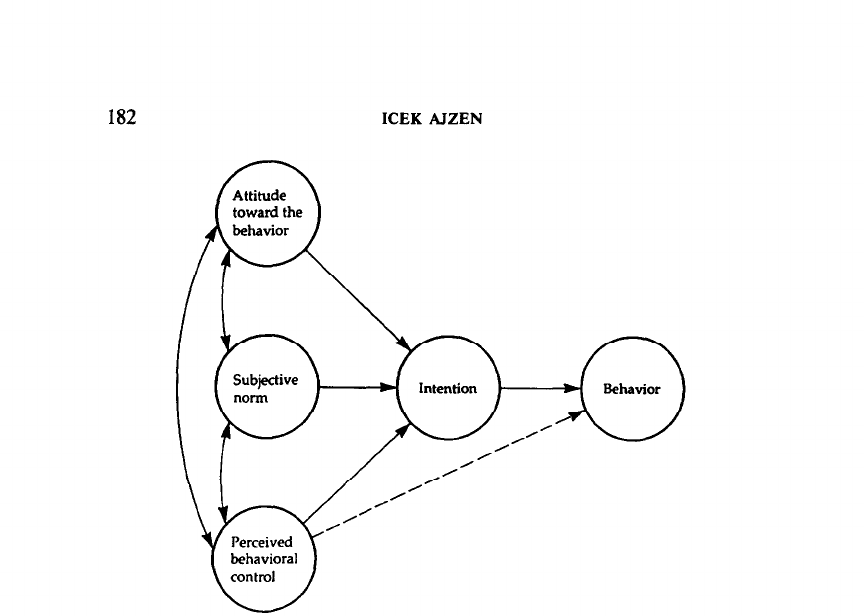
OriginalFigure 1 depicts the theory in the form of a structural diagram. For ease of presentation, possible feedback effects of behavior on the antecedent variables are not shown.
中文图 1 以结构图的形式描述了该理论。 为了便于演示,未显示行为对先行变量可能的反馈影响。
OriginalAs in the original theory of reasoned action, a central factor in the theory of planned behavior is the individual's intention to perform a given behavior. Intentions are assumed to capture the motivational factors that influence a behavior; they are indications of how hard people are willing to try, of how much of an effort they are planning to exert, in order to perform the behavior.
中文与最初的理性行动理论一样,计划行为理论的一个核心因素是个人执行特定行为的意图。 假设意图捕捉影响行为的动机因素;它们表明人们愿意付出多大的努力,以及他们计划付出多大的努力来执行该行为。
OriginalAs a general rule, the stronger the intention to engagein a behavior, the more likely should be its performance. It should be clear, however, that a behavioral intention can lind expression in behavior only if the behavior in question is under volitional control, i.e.,
中文一般来说,从事某种行为的意图越强烈,该行为的表现就越有可能。 应该 然而,要明确的是,只有当相关行为受到意志控制时,行为意图才能在行为中表达出来,即: